

Cushing’s Disease in Dogs: The Slow Imposter That Looks Like Aging

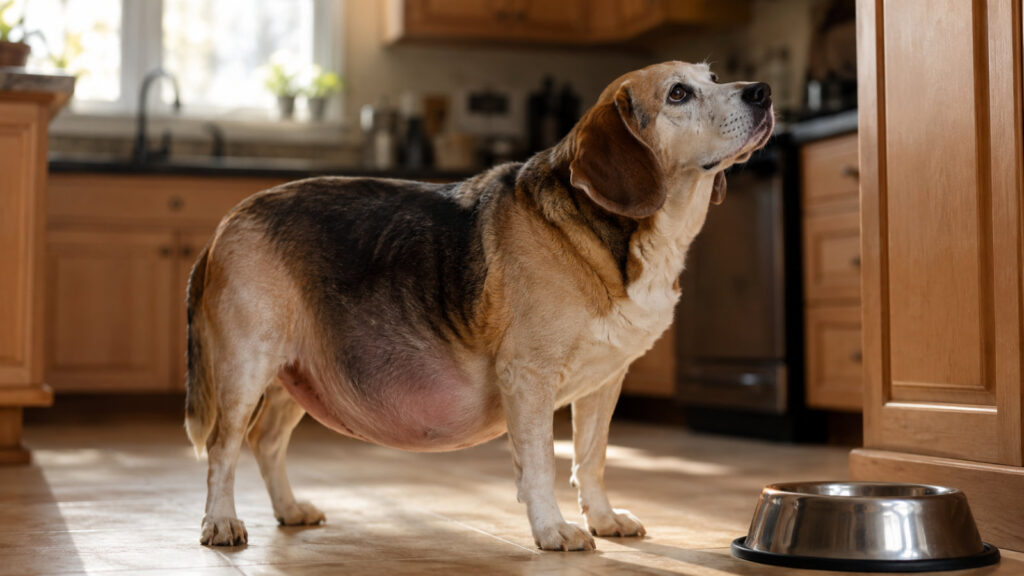
Cushing’s disease is the great imposter of senior dog medicine. It arrives one small change at a time (a little more water, a little more panting, a belly that rounds, a coat that thins), and every single piece can pass for ordinary aging. It is one of the most common hormonal diseases of older dogs, and one of the most commonly missed by loving owners for exactly that reason. If several of those small changes have been stacking up, this page is for you.
Quick answer
Cushing’s disease means the body makes too much cortisol, the stress hormone. In dogs it usually appears from middle age onward, and the classic signs cluster: drinking and urinating much more, a bigger appetite, heavy panting, a pot-bellied look, thinning skin and coat, and recurring skin or urinary infections. Diagnosis takes more than one test, treatment (most often the daily medication trilostane) controls it rather than cures it, and well-managed dogs commonly live comfortably for years.
The signs: the P’s that stack up
| Sign | What owners actually notice |
|---|---|
| Polydipsia and polyuria | The water bowl empties faster; accidents from a house-trained dog; asking out at night |
| Polyphagia | Sudden food obsession in a dog who was never a beggar: counter surfing, trash raids |
| Panting | Heavy panting at rest, in a cool room, at night, not tied to heat or play |
| Pot belly | A rounded, sagging abdomen while the legs stay thin: weakened belly muscles plus a larger liver |
| Skin and coat | Thinning fur (often symmetrical on the body), thin fragile skin, slow healing, recurring skin or bladder infections |
| Muscles and energy | Hind-leg weakness, less stamina, “slowing down” that is really muscle loss |
No single item on that list means Cushing’s; our guides to panting and drinking more walk the full differential. It is the stacking that tells: two, three, four of these together in a middle-aged or older dog is a pattern worth naming to your vet directly. Say the word Cushing’s: it points the workup.
Prefer paper? Download the printable 7-Day Water Log and Sign Checklist to measure what your dog actually drinks and arrive at the vet visit with the numbers the diagnosis needs.
What is actually happening
Cortisol is the body’s stress-and-metabolism hormone, and a healthy dog produces it in careful pulses. In Cushing’s disease the thermostat breaks: in most dogs (roughly 85 percent) the cause is a small, usually benign tumor of the pituitary gland at the base of the brain that keeps ordering more cortisol; in about 15 percent it is a tumor of an adrenal gland itself.
There is also a third, iatrogenic version (long-term steroid medication producing the same picture), which resolves by carefully adjusting the medication with your vet, never by stopping it abruptly. Chronically high cortisol is what produces every sign on the list: it redistributes fat, wastes muscle, thins skin, suppresses the immune system, and drives thirst.
How vets diagnose it, and why it takes more than one test
There is no single yes-or-no Cushing’s test, which is why the diagnosis can feel slow. The usual path: routine senior bloodwork and a urine test raise suspicion (a particular liver enzyme pattern and dilute urine are classic flags), then a dedicated hormone test confirms, most commonly an ACTH stimulation test or a low-dose dexamethasone suppression test, both of which measure how the cortisol system responds over a few hours at the clinic.
An ultrasound often follows to look at the adrenal glands and help distinguish the pituitary from the adrenal form. It is methodical because the treatment is lifelong and the diseases it mimics (diabetes, kidney disease, thyroid problems) need ruling out properly.
Treatment: control, not cure, and that is genuinely good news
The mainstay for most dogs is trilostane (brand name Vetoryl), the FDA-approved daily medication that blocks the final step of cortisol production. It does not remove the tumor; it turns the cortisol tap back toward normal, and the signs recede with it: the drinking settles first for many dogs, the coat and muscles rebuild more slowly over months.
Because the dose is a balance, expect monitoring bloodwork on a schedule your vet sets, especially in the first months. Surgery has a role in selected adrenal-tumor cases. Untreated, chronically high cortisol quietly raises the risk of infections, high blood pressure, blood clots, and diabetes, which is why treating visible signs is about more than comfort.
What are the final stages of Cushing’s disease in dogs?
Asked honestly and answered honestly: most dogs with Cushing’s do not die of Cushing’s. Managed well, it is a disease dogs commonly live with for years, and many eventually pass from something unrelated. When Cushing’s itself progresses hard (usually the untreated disease, or a pituitary tumor that grows), the late picture looks like: weakness to the point of collapsing on short walks, relentless infections that stop responding, neurological changes (circling, disorientation, personality change) from tumor pressure, or the complications: blood clots, uncontrolled diabetes.
At that stage the conversation shifts from control to comfort, and it is a quality-of-life conversation: our quality-of-life guide and its printable score sheet were built for exactly these weeks. What matters is that this stage is usually far from where you are standing now; a newly diagnosed dog with a treatment plan is at the beginning of management, not the end of the road.
When to see your veterinarian
Book a visit if two or more of the classic signs have stacked up, especially new thirst plus panting plus any belly or coat change. Go promptly if a dog on treatment becomes weak, wobbly, vomits, or refuses food (cortisol can swing too low on medication; that is treatable and time-sensitive). And any sudden collapse or labored breathing is an emergency regardless of cause.
References and further reading
- Merck Veterinary Manual. Cushing syndrome (hyperadrenocorticism) in animals.
- VCA Animal Hospitals. Cushing’s disease in dogs.
- U.S. FDA. Treating Cushing’s disease in dogs.
Frequently asked questions
What are the first signs of Cushing’s disease in a dog?
Usually increased drinking and urination, often with a bigger appetite and more panting, subtle enough to pass for aging. The pot belly, coat thinning, and skin changes tend to come later.
How long can a dog live with Cushing’s disease?
With treatment and monitoring, commonly years, and many dogs pass from unrelated causes of age. Outlook depends on the form, the dog’s other health, and how well the cortisol is controlled, which is your vet’s ongoing job with monitoring bloodwork.
Is Cushing’s disease painful for dogs?
The disease itself is not typically painful, but its effects (infections, muscle weakness, skin problems) erode comfort. Treating it is about restoring quality of life as much as preventing complications.
Is a dog with Cushing’s suffering?
A treated, monitored dog with controlled signs is generally living a good life. Suffering enters with the unmanaged late stage, and the honest measure is the day-to-day: appetite, engagement, mobility, more good days than bad. Our quality-of-life score sheet makes that measurable.
Educational content, not a substitute for veterinary advice. If your dog seems unwell, contact your veterinarian.
This guide is educational and is not a substitute for veterinary diagnosis or care. If you are worried about your dog, talk to your veterinarian.