

Senior Dog Panting and Drinking More: What It Can Mean

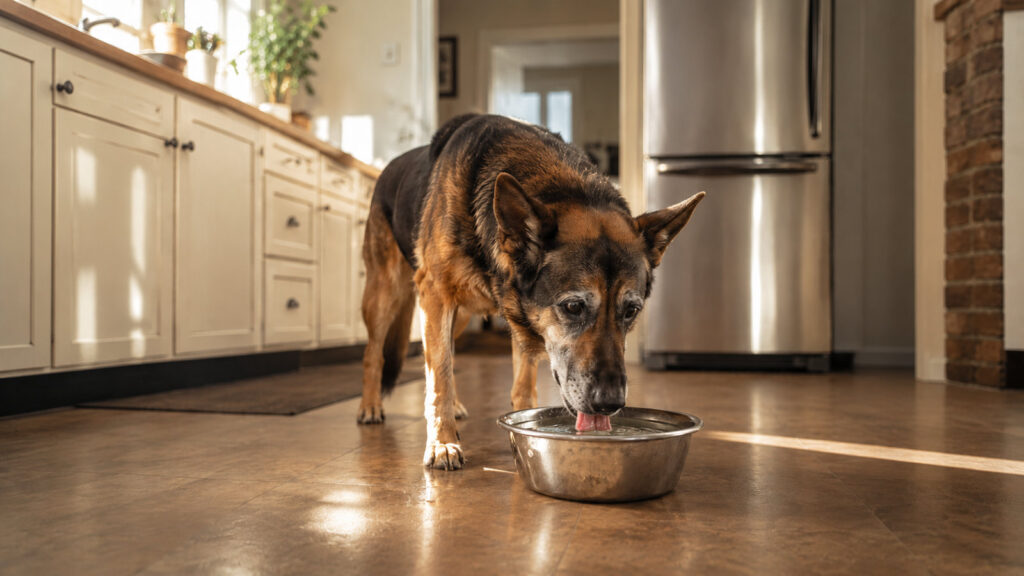
This page exists because of a pattern owners describe with two details: an old dog panting more than the weather explains, and a water bowl that suddenly needs refilling. Sometimes there is a third detail – night restlessness – and sometimes a fourth: more trips outside to urinate. Vets take this combination seriously, and you should too, in the calmest possible way: the list of causes is well known, the tests that sort them are routine, and most of the causes are manageable – especially caught now rather than in three months.
Quick answer
Increased thirst and urination with panting in an older dog is not normal aging. The common causes are chronic kidney disease, diabetes, and Cushing’s disease, with urinary tract infections and some medications as mimics – and panting alone can also signal pain or heart trouble. A vet visit with bloodwork and a urine test sorts most of it out quickly. Do not restrict water while you wait; measure it instead.
The differentials: what this pattern can be
| Cause | The tell alongside thirst | The good news |
|---|---|---|
| Chronic kidney disease | Gradual weight loss, softer appetite, more urine (dilute, pale) | Very manageable caught early – diet and monitoring slow it; see kidney disease in older dogs |
| Diabetes | Big appetite with weight loss; sudden-onset thirst | Treatable; dogs do well once regulated |
| Cushing’s disease | The full house: thirst, hunger, panting, a pot-bellied look, thinning coat and skin | Confirmed with specific tests; treatable – “it is not normal aging” |
| Urinary tract infection | Urgency, accidents, straining – can mimic or accompany the above | A urine test finds it; many are straightforward to treat once confirmed |
| Pain or heart disease (panting-first pattern) | Panting at rest or at night without matching thirst | Pain has treatments; for breathing changes see the heart guide |
One more pattern belongs on this list because owners find this page at 2am: panting and pacing at night in a dog whose thirst has not changed – especially with confusion or restlessness – points toward cognitive change rather than the conditions above. That picture has its own guide: senior dog panting at night.
What the vet will actually do
The workup for thirst-plus-panting is one of the most standard in senior medicine – it is the same sequence Dr. Fossum describes running on her own dog in the book: blood work to check kidney function and blood sugar, a urinalysis to assess urine concentration and rule out infection, imaging if the exam points that way, and a blood pressure measurement, since kidney disease and blood pressure travel together. None of it is exotic, much of it comes back same-day or next-day, and between the blood panel and the urine test, your vet can usually tell whether kidneys, diabetes, or Cushing’s need the next step. Cushing’s, when suspected, gets its own confirmatory tests.
What to do before the appointment
Three things make the visit dramatically more useful. Measure the water: fill a marked jug in the morning, pour all bowl refills from it, and note the total for two or three days (and how it compares to a month ago). Note the pattern: when the panting happens – at rest, at night, after stairs – and whether appetite is up, down, or unchanged. And bring a fresh urine sample if you can collect one on the morning of the visit – first-morning urine tells the concentration story best. What not to do: restrict water. A dog drinking heavily is compensating for something; taking the bowl away does not fix the something, and it can make a sick dog sicker.
When this is urgent
Book promptly for the thirst-panting pattern in any senior dog – days, not weeks. Treat it as urgent if there is also vomiting, refusal to eat, marked lethargy, labored breathing at rest, or a dog straining to urinate and producing little – that last one can be an emergency in its own right.
References and further reading
- Veterinary Partner (VIN). Polyuria/polydipsia in dogs and cats.
- University of Illinois College of Veterinary Medicine. Cushing’s disease in dogs: it is not normal aging.
- Fossum TW, Ford S. Senior Dogs: The Essential Guide (2024), Chapter 5: Chronic Kidney Disease.
Frequently asked questions
Why is my old dog panting and drinking so much water?
The common medical causes are kidney disease, diabetes, and Cushing’s disease, with urinary infections as a mimic. It is a pattern worth a prompt vet visit with bloodwork and a urine test – not a wait-and-see situation, and not normal aging.
How much water is too much for a dog?
As a rough gauge, intake creeping past about an ounce per pound of body weight per day – or any clear jump from your dog’s own normal – is worth measuring for a few days and reporting to your vet. The trend matters more than any single day.
Should I limit my dog’s water if they are drinking too much?
No. Heavy drinking is usually compensation for a real problem, and restricting water can dehydrate a dog whose body needs it. Measure, note, and see the vet instead.
My senior dog pants at night but is not drinking more – same thing?
Different pattern. Night panting with restlessness or confusion, without thirst changes, points more toward pain or cognitive change – see our guide to senior dogs panting at night for that picture.
Educational content, not a substitute for veterinary advice. If your dog seems unwell, contact your veterinarian.
This guide is educational and is not a substitute for veterinary diagnosis or care. If you are worried about your dog, talk to your veterinarian.