

CBD Oil Dosage Calculator for Pets
There is no single official dose of CBD for pets. As Cornell University's Riney Canine Health Center puts it plainly, no standard therapeutic dose has been established. What we do have is a growing body of veterinary research and a sensible, weight-based way to translate it into a starting amount you can actually use. The calculator below does the math for you in a few seconds, and the rest of this guide explains where the numbers come from, how to measure a dose, how long a bottle should last, and how to adjust safely.
Calculate your pet's dose
Vet-formulated dosing toolEnter your pet's weight for a starting dose in milligrams and milliliters, twice daily. Works with Dr. Fossum's Rejuvenator oil or any CBD product.
Both numbers are on the bottle. Example: 750 mg in a 30 ml bottle = 25 mg/ml.
Example result for a 30 lb dog (general wellness). Enter your pet's weight above to get your own numbers.
Give twice a day, morning and night
using Rejuvenator Medium Dog CBD Oil (25 mg/ml)
For everyday support, many pets settle at or a little below the maintenance amount long-term. Consistency matters more than the exact milligram; adjust with your veterinarian.
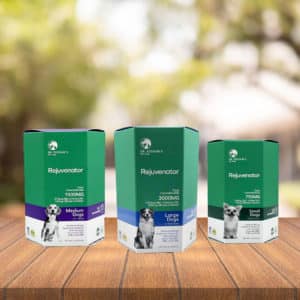
Rejuvenator Medium Dog CBD Oil
for dogs 21-60 lb, 60 ml, broad spectrum and THC-free
Get your pet’s full plan by email
The week-1 loading schedule, the day-8 maintenance amount, refill timing for your bottle, and a 20% first-order code.
Starting CBD? Track the first 30 days with the free response diary - sixty seconds a day, and you will actually know whether it is working.
How we calculate: body weight × 2 mg per kg per dose for the first seven days (the loading phase, the amount used in the Cornell dosing study; Gamble et al., 2018), then body weight × 1 mg per kg for maintenance, each given twice daily. It is a starting point, not a prescription. Your veterinarian should have the final word.
How much CBD oil should I give my dog?
A practical starting answer: about 1 to 2 mg of hemp extract per kilogram of body weight, per dose, twice daily. In pounds, that is roughly 0.9 mg per pound for the first seven days (a gentle loading phase, the amount used in the Cornell dosing study, where it was well tolerated), then about 0.45 mg per pound from day eight onward for maintenance. There is no official standard dose, so start low and confirm the amount with your veterinarian. The calculator above turns this into exact milligrams and milliliters for your dog's weight.
Why twice a day? In dogs, CBD has a short half-life of roughly four hours, so blood levels rise and then fall within the same day. Splitting the amount into a morning and an evening dose keeps things steadier than one large dose (Gamble et al., Cornell, 2018). You can always go up slowly; it is much harder to undo giving too much at once. Cats use the same weight-based logic at gentler amounts - the cat chart below and the cat question in the FAQ cover them.
CBD oil dosage chart for dogs (by weight, in mg and ml)
Amounts are hemp extract per dose, given twice daily. Use the loading column for the first seven days, then move to maintenance, which is about half. The milliliter figures are for the size-matched Dr. Fossum's Rejuvenator oil (small dogs use the 12.5 mg/ml oil, medium dogs the 25 mg/ml, large dogs the 50 mg/ml), so the milliliters do not simply rise with weight.
| Dog weight | First 7 days (loading), twice daily | Day 8 onward (maintenance), twice daily |
|---|---|---|
| 5 lb | 4.5 mg (0.36 ml) | 2.3 mg (0.18 ml) |
| 10 lb | 9.1 mg (0.73 ml) | 4.5 mg (0.36 ml) |
| 15 lb | 13.6 mg (1.09 ml) | 6.8 mg (0.54 ml) |
| 20 lb | 18.1 mg (1.45 ml) | 9.1 mg (0.73 ml) |
| 30 lb | 27.2 mg (1.09 ml) | 13.6 mg (0.54 ml) |
| 40 lb | 36.3 mg (1.45 ml) | 18.1 mg (0.73 ml) |
| 50 lb | 45.4 mg (1.81 ml) | 22.7 mg (0.91 ml) |
| 60 lb | 54.4 mg (2.18 ml) | 27.2 mg (1.09 ml) |
| 75 lb | 68 mg (1.36 ml) | 34 mg (0.68 ml) |
| 100 lb | 90.7 mg (1.81 ml) | 45.4 mg (0.91 ml) |
| 125 lb | 113.4 mg (2.27 ml) | 56.7 mg (1.13 ml) |
| 150 lb | 136.1 mg (2.72 ml) | 68 mg (1.36 ml) |
CBD oil dosage chart for cats
Cats use the same weight-based approach with two extra cautions. First, cats reach lower blood levels than dogs at the same dose, so they need a precise, weight-based amount and slow adjustment. Second, cats are more sensitive to THC, so a cat product should be THC-free. These amounts of our feline oil (about 7 mg/ml) are per dose, twice daily. Start at the low end.
| Cat weight | Per dose, twice daily | Amount (ml) |
|---|---|---|
| 2 lb | 0.9 mg | 0.13 ml |
| 4 lb | 1.8 mg | 0.25 ml |
| 5 lb | 2.3 mg | 0.32 ml |
| 6 lb | 2.7 mg | 0.38 ml |
| 8 lb | 3.6 mg | 0.51 ml |
| 10 lb | 4.5 mg | 0.63 ml |
| 12 lb | 5.4 mg | 0.76 ml |
| 14 lb | 6.4 mg | 0.89 ml |
| 16 lb | 7.3 mg | 1.02 ml |
Prefer paper? Download the printable dose chart (PDF) with both tables on one page for the fridge or the vet visit.
New to CBD for cats? Our full CBD-for-cats guide covers safety, what to look for in a cat-specific product, and the signs it is helping.
What about horses?
Horses are dosed far lower per pound than dogs, and routines vary widely. As a rough starting point, a 1,000 to 1,200 lb horse often begins near 2 ml twice daily of a high-concentration oil, then adjusts downward over time. The calculator's horse mode gives a weight-based starting dose in milligrams; because most horse owners use a high-concentration equine oil, enter your product's strength in the "Any CBD product" mode to get exact milliliters. Always set the final amount with your equine veterinarian.
Dosing by goal: calm, joints and senior support
Every goal uses the same weight-based schedule: about 2 mg per kg per dose for the first week, then about 1 mg per kg from day eight, twice daily. What changes is the guidance around the dose. In every case, adjust over one to two weeks with your veterinarian.
- General wellness and daily support. Run the standard schedule; many pets then settle at or a little below the maintenance amount long-term. Consistency matters more than the exact milligram.
- Calm and stress support. Same schedule, plus timing: give a dose about one to two hours before a stressful event such as a thunderstorm, car ride or houseguests, so it is on board when your pet needs it.
- Joint comfort and mobility. The 2 mg per kg amount is the dose used in the Cornell dosing study (Gamble et al., 2018). Older or stiff dogs often stay closer to the loading amount, with your vet's okay.
- Neurological conditions. We do not publish a dose for any neurological condition, in this calculator or anywhere else: that care belongs with your veterinarian, and CBD can interact with the medications used for it. Our safety guide covers the interaction questions to bring to your vet.
- Senior support. Same schedule, plus monitoring: pair it with regular check-ins and periodic bloodwork, which is good practice for any senior pet on a long-term supplement. Our CBD for senior dogs guide covers what to expect.
How to measure a dose (turning milligrams into milliliters)
A milligram is an amount of CBD; a milliliter is an amount of liquid. To get from one to the other you need the strength of your oil, which is printed on the bottle. If the label terms are confusing, our hemp vs. CBD guide explains what broad spectrum, full spectrum and hemp extract actually mean.
Strength (mg per ml) = total mg in the bottle ÷ bottle size in ml.
For example, a 30 ml bottle labeled 750 mg is 25 mg per ml. If your dog needs 9 mg, that is 9 divided by 25, which is about 0.36 ml. Measure by the milliliter marks on an oral syringe rather than counting drops, because drop size varies and "drops per ml" is only a rough guide (about 20 drops to a milliliter). If you use one of our oils, the calculator above already converts everything to the exact milliliters for that bottle.
How long will a bottle last?
This is the question we get most, and it is one most calculators ignore. The answer depends on three things: your pet's weight, the strength of the oil, and whether you are in the loading week or on the maintenance amount. For most goals the maintenance dose is half the loading dose, so a bottle stretches much further after the first week. The calculator above shows your pet's days-supply and estimated cost per day for each of our oils, so you can see the real monthly cost before you buy.
Check the true cost (price per milligram)
A cheap-looking bottle can be the most expensive CBD you ever buy if it is weak. The honest comparison is price per milligram: divide the price by the total milligrams in the bottle. Enter any product's numbers to compare.
For reference, our Rejuvenator dog oils work out to about $0.050 (small), $0.040 (medium), $0.032 (large) per milligram of total cannabinoids at current prices. Compare that number, not the sticker price.
Running a trial after you buy? Download the printable 14-day trial diary (PDF) to track the change day by day.
Oil, capsules or treats: which to choose
Oil (tincture) is the most flexible and, in head-to-head veterinary testing, gave the most consistent absorption. It lets you fine-tune the amount and adjust drop by drop while you find the right level, and onset is usually quickest because some is absorbed in the mouth. Capsules and treats are convenient and pre-measured for daily use once you know the amount that works; they take a little longer to act because they must be digested. A common routine is to titrate with oil, then keep a pre-measured option for convenience. Still deciding? Our guide to choosing a CBD product walks through strength, format and what a trustworthy label looks like.
With food or on an empty stomach?
Either is fine; the most important thing is to be consistent. Giving CBD with a meal that contains some fat tends to increase how much is absorbed, while an empty stomach may bring on effects a little faster. Pick one routine and keep to it.
Is it safe? What the research shows
In controlled studies, CBD has been generally well tolerated by healthy pets. Dogs tolerated about 4 mg per kg per day for six months, and cats tolerated a THC-free product at a similar level for about six months, without serious problems. The one consistent laboratory finding is a rise in a single liver enzyme, alkaline phosphatase (ALP), in some dogs; in the six-month study it returned to normal after the product was stopped. That is why we recommend looping in your veterinarian and doing periodic bloodwork for any pet on CBD long-term or on other medications.
True overdoses of pure CBD are uncommon and usually show up as mild stomach upset or sleepiness. More serious reactions almost always trace back to a product contaminated with THC, which is toxic to dogs and cats. This is the single biggest reason to use a broad-spectrum, THC-free product with a current Certificate of Analysis, and to keep all cannabis products well out of your pet's reach. Every batch of Dr. Fossum's oils is tested by an ISO/IEC 17025-accredited independent lab, and the current certificates are public.
CBD and your pet's medications
CBD is processed by the liver's cytochrome P450 enzymes, the same pathway that clears many medications, so it can slow their breakdown and raise their blood levels. The clearest concern is for pets already taking NSAIDs, certain seizure medications, or any drug with a narrow safety margin. If your pet takes any medication, talk to your veterinarian before starting CBD, and consider periodic bloodwork so the two can be managed together.
Talk to your veterinarian if
- your pet takes other medications (CBD can affect how the liver processes some drugs),
- your pet is pregnant, nursing, or has known liver disease,
- you are dosing a cat, a very small dog, or a very large dog,
- or you simply are not sure where to start. A quick conversation beats guessing.
Keep reading
Frequently asked questions
How much CBD oil should I give my dog per pound?
A common starting point is about 0.9 mg per pound of body weight for the first week, then about 0.45 mg per pound for maintenance, given twice a day (roughly 2 mg/kg then 1 mg/kg per dose). There is no official standard dose, so start low and confirm the amount with your veterinarian.
How much CBD oil should I give my cat?
A common starting point for cats is about 0.45 mg per pound of body weight (roughly 1 mg per kg), twice daily, started at the low end and increased slowly. Cats reach lower blood levels than dogs and are more sensitive to THC, so use a THC-free product and dose only with your veterinarian.
Can I give my pet too much CBD?
CBD has a wide margin of safety, and too much usually causes nothing worse than mild stomach upset or drowsiness. Serious reactions are typically a sign of THC contamination, which is why a THC-free product matters. If you ever see more than mild drowsiness, call your veterinarian or a pet poison helpline.
How often should I give it?
Twice a day, about every 12 hours. CBD clears a dog's system within hours (half-life about four hours), so two smaller doses keep levels steadier than one large one.
How long until I see a difference?
It varies by pet and by goal. Oils tend to act fastest, often within about 15 to 30 minutes, while chews and capsules take longer because they must be digested. For everyday goals, give it consistently and reassess over one to two weeks.
Is dosing different for a 1000 mg or 300 mg bottle?
Yes. What matters is the strength in milligrams per milliliter, which is the total CBD in the bottle divided by the bottle size in ml. A 1000 mg / 30 ml bottle is about 33 mg/ml; a 300 mg / 30 ml bottle is about 10 mg/ml. Use the universal mode of the calculator to convert any bottle to the exact dose.
Is CBD safe for my pet long-term?
In controlled studies, dogs and cats tolerated daily CBD for about six months. The main finding was a reversible rise in one liver enzyme (ALP) in some dogs, which is why periodic veterinary check-ins and bloodwork are a good idea for long-term use or medicated pets.
Can CBD interact with my pet's medications?
It can. CBD is processed by the same liver enzymes (cytochrome P450) as many drugs, so it can slow the clearance of medications such as some NSAIDs and seizure drugs. If your pet takes any medication, talk to your veterinarian before starting CBD.
What about horses?
Horses are dosed at much lower amounts per pound than dogs, and routines vary widely. As a rough guide, a 1,000 to 1,200 lb horse often starts near 2 ml twice daily of a high-concentration oil, then adjusts with an equine veterinarian. The calculator's horse mode gives a weight-based starting point in milligrams; use the "Any CBD product" mode with your oil's strength for exact milliliters.

Reviewed by Dr. Terry Fossum, DVM, MS, PhD, DACVS, a board-certified veterinary surgeon, founder of Dr. Fossum's Pet Care, and author of Small Animal Surgery, a standard veterinary surgical textbook. This guide is educational and is based on the published veterinary research listed below. It is not a substitute for advice from your own veterinarian. Last reviewed July 2026.
References
- Gamble L-J, et al. Frontiers in Veterinary Science, 2018 (Cornell): the four-week dosing study behind the 2 mg/kg starting amount. View study
- McGrath S, et al. JAVMA, 2019 (Colorado State): a randomized blinded trial in dogs on veterinary medication, cited for the drug-interaction picture. View study
- Bartner LR, et al. Pharmacokinetics of cannabidiol administered by 3 delivery methods at 2 different dosages to healthy dogs. Canadian Journal of Veterinary Research, 2018. View study
- Bradley S, Bakke AM, et al. Long-term daily feeding of cannabidiol is well tolerated by healthy dogs. Frontiers in Veterinary Science, 2022. View study
- Deabold KA, et al. Single-Dose Pharmacokinetics and Preliminary Safety Assessment of CBD in Healthy Dogs and Cats. Animals, 2019. View study
- Coltherd JC, et al. Healthy cats tolerate long-term daily feeding of cannabidiol. Frontiers in Veterinary Science, 2024. View study
- Cornell Riney Canine Health Center. The ABCs of cannabidiol (CBD) from hemp. View source
- Merck Veterinary Manual. Toxicosis in dogs and cats from THC and from cannabidiol (CBD). THC entry · CBD entry
These statements have not been evaluated by the Food and Drug Administration. This product is not intended to diagnose, treat, cure, or prevent any disease. Always consult your veterinarian before starting any new supplement, especially if your pet is on other medications.