

Gastropexy: The Bloat-Prevention Surgery Every Giant-Breed Owner Should Know About

Our emergency guide teaches every dog owner the bloat presentation, the unproductive retching, the swelling belly, the drive-now clock. This page is for the owners who can act BEFORE that night: people with Great Danes, standard poodles, weimaraners, and the other deep-chested breeds, for whom a preventive surgery exists that takes most of the deadly half of bloat off the table. It is called gastropexy, tacking the stomach to the body wall so it is very unlikely to twist, and for the highest-risk breeds it is one of the most defensible elective decisions in veterinary medicine. Here is the honest case, both directions.
Quick answer
Gastropexy surgically attaches the stomach to the abdominal wall, making rotation very unlikely, heading off the VOLVULUS (twist) that turns bloat from an urgent problem into a killing one. It does not prevent gas bloat itself, and a bloating pexied dog still needs a vet immediately, but the twist is what kills in hours, and the twist is what the pexy is built to prevent.
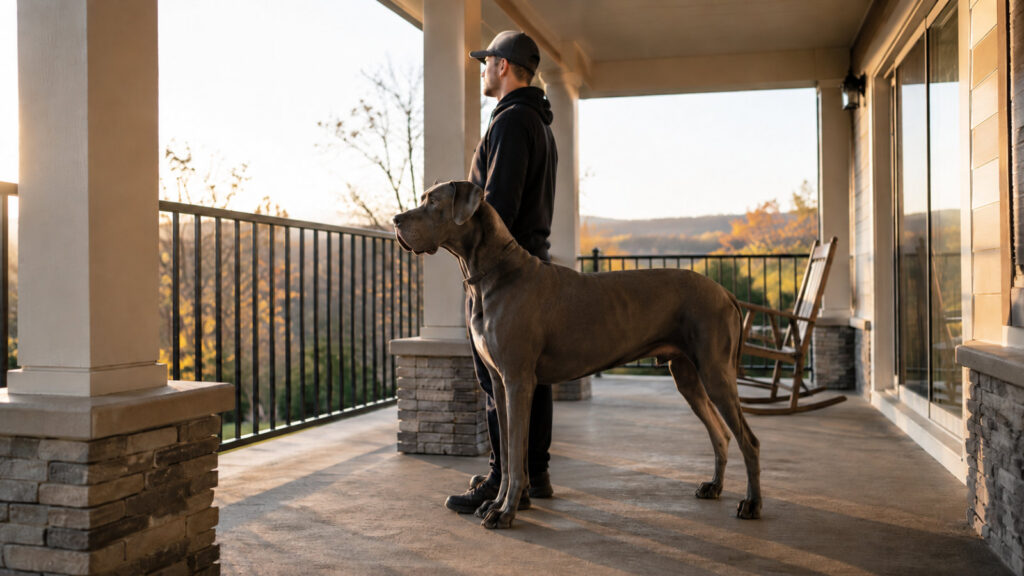
The candidates: deep-chested high-risk breeds, Great Danes above all (studies put their lifetime GDV risk remarkably high), plus standard poodles, weimaraners, setters, saint bernards, and dogs with a first-degree relative who bloated. The efficient window: done laparoscopically or alongside spay/neuter, it adds modest cost and recovery to a procedure already happening. A dog who survives GDV surgery gets one automatically, the logic of doing it BEFORE the emergency is the whole page.
The twist is the killer (why tacking works)
Bloat (GDV) is two events stacked: the stomach fills with gas (dilatation (miserable, treatable), and then) in the deadly version – rotates on its axis (volvulus), sealing both exits, strangling its own blood supply, compressing the great veins, and starting a shock clock measured in hours. The emergency guide’s drive-now rules exist for that second event.
Gastropexy attacks the mechanism directly: a permanent adhesion between stomach and body wall means the stomach can still fill with gas (a pexied dog can still bloat, the honest limit) but is very unlikely to flip, and bloat without the twist, while still a serious go-in-now event, can often be managed with decompression rather than emergency surgery on a shocked patient at 2 a.m. The home urgency does not change, though: a distended or retching pexied dog goes in immediately, because nobody can tell from the living room whether the twist happened.
The logic behind the recommendation: recurrence of the twist after emergency treatment WITHOUT a pexy is high enough that adding one is standard during every GDV surgery, and with a pexy in place, recurrence of volvulus becomes rare. Prevention-side, the breed math does the arguing: deep-chested giants carry lifetime GDV risks high enough (Great Danes are the textbook case, with lifetime risk estimates that startle first-time owners) that many breed clubs and surgeons now discuss prophylactic pexy as routinely as they discuss spay timing.
The decision, honestly: who, when, how, and how much
Who should consider it
The risk stack is breed (Danes, standard poodles, weimaraners, setters, saints, bloodhounds, and deep-chested mixes), build (the taller-and-narrower the chest, the higher the risk), family history (a bloated parent or sibling is a strong vote), age (risk climbs with years), and history (any prior gas-bloat episode = a very strong vote). A lean, small-chested mutt with no family history rarely needs this conversation; a Dane puppy’s family absolutely does, and in between, the risk stack outranks appearances.
When and how, the efficiency window: the elegant version is combining it with an already-planned anesthesia, at spay or neuter (the young-adult classic: one anesthesia, one recovery), or laparoscopically as its own minimally-invasive procedure (small incisions, quick recovery; increasingly the standard where available).
Cost honesty: as an add-on to spay/neuter or done laparoscopically, commonly high-hundreds-to-low-thousands, against emergency GDV surgery at several-to-many thousands on a shocked patient with real mortality. The comparison-shopping question worth asking: “do you offer laparoscopic pexy, and what would it add to her spay?”
What it does NOT replace: the management basics still stand for every deep-chested dog, pexied or not, meals split rather than gorged, no hard exercise bracketing meals, gulpers slowed (the slow-feeder logic), and the bloat presentation memorized by the whole household, because a pexied dog with gas-bloat still needs a vet immediately – the pexy improves the odds; it does not buy home-monitoring time.
The conversations to have
For high-risk-breed puppies: raise prophylactic pexy AT the spay/neuter planning visit. The combo window is the cheapest it will ever be. For adult high-risk dogs never pexied: it is a legitimate standalone (often laparoscopic) conversation, especially with family history or a prior scare. And for every deep-chested household regardless: the emergency guide’s bloat presentation, memorized, the pexy changes the odds, not the need to know the signs. Regardless of pexy status: unproductive retching with a distending belly means drive now, every time.
References and further reading
- American College of Veterinary Surgeons. Gastric dilatation-volvulus.
- Merck Veterinary Manual. Gastric dilatation and volvulus in dogs.
Frequently asked questions
Does gastropexy prevent bloat completely?
It is built to make the twist, the part that kills, very unlikely. A pexied stomach can still fill with gas (uncomfortable, vet-worthy, treatable), but the twist becomes very unlikely; which usually converts the 2 a.m. emergency surgery into a treatable event. The signs still get memorized and a bloating dog still goes in immediately; the odds change dramatically, the urgency does not.
Should every Great Dane get a gastropexy?
It is the breed where the conversation is closest to a default yes, lifetime GDV risk estimates for Danes are high enough that many surgeons and breed organizations recommend prophylactic pexy routinely, ideally in the spay/neuter combo window. The final call weighs the individual dog with your vet, but the conversation itself is mandatory Dane ownership.
How much does a preventive gastropexy cost?
Combined with spay/neuter or done laparoscopically: commonly high-hundreds to low-thousands, region depending, versus emergency GDV surgery at several-to-many thousands with real mortality on the table. Ask specifically about the laparoscopic option and the combo pricing.
Can older dogs get a gastropexy?
Yes; adult and senior high-risk dogs are legitimate candidates, especially laparoscopically, with the usual senior pre-anesthesia workup. Family history or a prior gas-bloat scare moves the conversation from optional to prompt at any age.
Educational content, not a substitute for veterinary advice. If your dog seems unwell, contact your veterinarian.
This guide is educational and is not a substitute for veterinary diagnosis or care. If your dog is unwell, or you are unsure, talk to your veterinarian.