

The Bland Diet for Dogs: How to Do It Right, the Time Limit, and When It Is the Wrong Tool

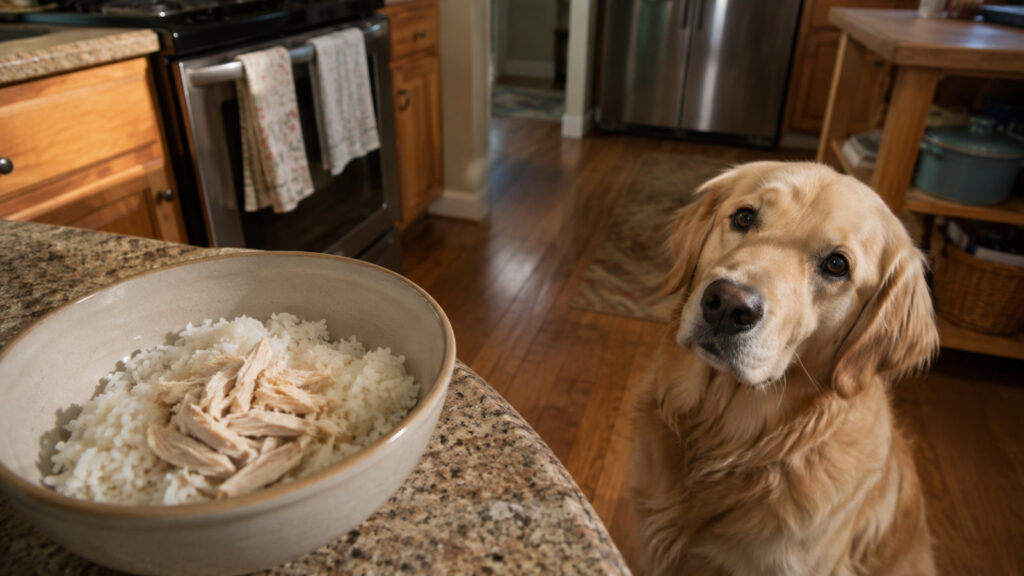
Chicken and rice is the most-given piece of advice in dog ownership, and one of the least explained. Used briefly, in the right dog, it is a reasonable bridge across a rough couple of days. It is also, fed past that, a diet that slowly shortchanges him, which is the part almost nobody mentions when they hand out the tip. Here is the protocol as veterinary sources actually describe it, the honest time limit, and the situations where reaching for it is the wrong move altogether.
Quick answer
A bland diet is a short-term, easily digested, simple meal that gives an irritated gut less work to do: plain boiled skinless chicken or another lean protein with plain cooked white rice, more rice than meat, in small meals several times a day, with water always available. It belongs to one specific situation (an otherwise-healthy adult dog with mild signs who is drinking, willing to eat, and behaving normally) for no more than 24 to 48 hours before you call. It is supportive care, not treatment.
Two things to hold onto. It is not a complete diet, one veterinary reference describes plain chicken and rice as short of more than ten essential nutrients, so it belongs in days, not weeks, and a dog who keeps needing it may have an unresolved dietary or medical issue. And the old advice to starve a dog first has largely been retired: modern guidance is to feed early rather than fast, and never to withhold water at all.
Why it works
An inflamed gut struggles with the ordinary job of breaking food down and absorbing it. The thinking behind a bland diet is to offer food that is absorbed easily and early, leaving less residue to travel on and ferment. Lower fat can help selected dogs, since fat is among the harder parts of a meal to handle. Familiar simple ingredients give less to react to. Small frequent portions move through the stomach more comfortably than one large meal.
Worth saying plainly, though: “bland diet” has no single agreed veterinary formulation, and how much any of this helps depends on the dog and on what actually caused the upset. That is part of why complete therapeutic gut diets have become the preferred tool, more on that below.
Notice what is not on that list: healing. The diet buys the gut easier working conditions. Whatever caused the upset is either resolving on its own or still waiting to be diagnosed.
The protocol, as vets actually describe it
- The protein: plain boiled or baked skinless, boneless chicken breast is the classic. Lean turkey breast, low-fat cottage cheese, or very lean ground beef with the fat poured off all appear in veterinary sources. Some vets also use plain white fish. Nothing seasoned, nothing fried, no skin, no bones.
- The carbohydrate: plain cooked white rice. Vets specify white rather than brown deliberately; the goal here is low fiber and easy digestion, and brown rice keeps the fibrous outer layer that ordinarily makes it the healthier grain.
- The proportion: more rice than meat. Use the rice-to-protein proportion and the total daily amount your veterinarian recommends for your dog. Both depend on his size and on what is wrong.
- The schedule: small portions, several times a day rather than one or two big meals.
- Water: always available, always. This is not optional and it is not part of any fasting advice.
- Nothing added: no salt, no butter, no oil, no seasoning, and above all nothing containing onion or garlic in any form – both damage red blood cells in dogs, garlic more so than onion, and the signs can appear days later.
- Handle it like your own food: cook it through, refrigerate leftovers promptly, and do not leave it sitting out.
Download the printable Bland Diet Card (PDF): the before-you-cook check, the protocol table, and the three-day transition back to normal food on one page for the kitchen.
About starving him first
This is the part of the standard advice that has genuinely changed, and it is worth stating plainly because the older version is still repeated everywhere.
The veterinary manuals now say that providing nutrition earlier is associated with earlier improvement. Prolonged fasting, beyond about two days, works against a recovering gut, because the intestinal lining depends on food passing over it to stay healthy. In the small trial that shifted thinking, parvovirus puppies fed early reached normal demeanour, appetite, and stools about a day sooner than those held off food; though survival itself was not significantly different.
What that means in practice: a brief pause after active vomiting is reasonable, and your vet may suggest one. A multi-day fast imposed at home is not. And some dogs must never be fasted without direction; puppies (a long gap is genuinely risky for them), tiny breeds, diabetic dogs, any dog on medication with food, and cats, where even a few days without eating can trigger serious liver disease.
Water is never withheld. If your dog cannot keep water down, that is not a feeding question. That is a call to your vet.
The honest limitation nobody mentions
Plain chicken and rice is not a complete and balanced diet. One veterinary reference puts it bluntly: it falls short on more than ten essential nutrients. It is fine as a bridge across a bad few days. Fed for weeks or months, it does real harm, and this is not a fringe concern, since a review of two hundred home-prepared dog recipes found the overwhelming majority came up short on at least one essential nutrient, with most short on several.
So the time limit is days, not weeks. Most sources describe a couple of days to about a week, and a longer course belongs to your vet. Who will usually reach for a complete therapeutic gut diet instead, precisely because it is balanced, consistent, and tested for this job.
And the more important limit: a dog who needs a bland diet every few weeks has something unresolved, which may well be dietary, and may be medical. Repeated treats and table food, a food intolerance, parasites, chronic gut inflammation, and pancreatic disease all hide behind a pattern of upsets that keep half-resolving on chicken and rice. The pattern deserves a workup rather than another round of cooking.
Getting back to normal food
Once stools have been normal for a day, mix the regular food back in gradually across two to three days, a little more each meal. Racing straight back to a full bowl of the usual food is the classic cause of a relapse, because an abrupt diet change is itself a common trigger for the upset you just recovered from.
If stools loosen again during the transition, drop back a step for a day rather than starting over, and if it happens twice, call your vet instead of running the experiment a third time.
When a bland diet is the wrong tool
- Suspected pancreatitis. This is a diagnose-and-prescribe illness, and a painful vomiting dog needs a vet rather than a saucepan. Your vet will set the feeding plan, often a therapeutic low-fat diet, our pancreatitis guide covers what the evidence does and does not support about dietary fat.
- A dog who cannot keep anything down, or who is vomiting repeatedly. Feeding trials are not the answer to that; a vet is.
- Any suspicion of a swallowed object. Feeding a possible obstruction is actively unhelpful; see the swallowed-object rules, which start with calling at ingestion.
- Puppies with diarrhea. Parasites and parvovirus outrank diet here, and puppies have very little margin. Call rather than cook.
- Anything not clearly improving within 48 hours: that is the point to call, not to extend the cooking. Signs running on for weeks are chronic by definition and need a diagnostic workup rather than repeated home-diet trials.
- Dogs with chronic illness (kidney disease, diabetes, liver disease) whose diets are doing a job a bland diet cannot do.
The popular add-ons, honestly
- Plain canned pumpkin (never pie filling, which is sweetened) is generally well tolerated in small food amounts and many dogs enjoy it. What it is not is a meaningful dose of fiber: a veterinary nutritionist’s analysis found you would need an implausible quantity daily to match what a therapeutic high-fiber diet delivers. Use it if your dog likes it; ask your vet for a proper fiber supplement if fiber is actually the goal.
- Probiotics have real but strain-specific and mixed evidence, as our probiotics page lays out. Ask which product and which strain rather than grabbing one off a shelf.
- Broth is fine as a way to add moisture or tempt an appetite, with conditions: check the label for onion, garlic, and xylitol, keep it unseasoned and not greasy, and be careful with commercial broths in any dog with heart, kidney, or pancreatic disease, since even low-sodium versions can carry more salt than suits them. Plain unseasoned homemade avoids most of those traps.
- Human anti-diarrhoeal and stomach medicines have no place here without your vet naming one for your dog. Several are genuinely dangerous, and some breeds are far more vulnerable than others.
When to see your veterinarian
Call if the upset has not clearly improved within 48 hours, if your dog needs a bland diet more than occasionally, if he will not eat the bland food, or if he loses weight during a bout. Puppies, seniors, tiny breeds, diabetic dogs, and any dog on regular medication should be called about sooner rather than home-managed.
Skip the kitchen and get seen for: more than a faint streak of blood or any black tarry stool, repeated vomiting (a second vomit the same day counts), a dog who will not keep water down, lethargy or weakness, or a bloated painful belly. With unproductive retching on top, that is bloat: drive now.
References and further reading
- Linder D. Does my pet need a bland diet? Tufts Petfoodology.
- VCA Animal Hospitals. Bland diet instructions for dogs and cats.
- Cornell Riney Canine Health Center. Diarrhea.
- Merck Veterinary Manual. Disorders of the stomach and intestines in dogs.
- Freeman L. The problem with pumpkin. Tufts Petfoodology.
Frequently asked questions
How much chicken and rice should I feed my dog?
More rice than meat, divided into small portions several times a day rather than one or two large meals. Both the proportion and the total amount depend on your dog’s size and on what is wrong, so ask your vet for the numbers rather than working from a recipe you found online.
How long can a dog stay on a bland diet?
Days, not weeks. Plain chicken and rice is missing more than ten essential nutrients, so it is a bridge rather than a diet, and feeding it for weeks or months causes real harm. If your dog needs a special diet for longer than about a week, that is your vet’s call, usually a complete therapeutic gut food rather than home cooking.
Should I fast my dog before starting a bland diet?
Not for long, and not on your own initiative. Modern veterinary guidance favors feeding early over prolonged fasting, since a gut with nothing passing through it recovers more slowly. A short pause after active vomiting is reasonable. Never fast a puppy for long, a tiny breed, a diabetic dog, or a cat, and never withhold water from any of them.
Can I use brown rice instead of white?
Stick with white for this job. The whole point is low fiber and easy digestion, and brown rice keeps the fibrous bran that normally makes it the healthier choice. Save the brown rice for a healthy gut.
Why does my dog keep needing a bland diet?
Because something is still unresolved, dietary or medical. Repeated upsets that keep half-resolving on chicken and rice can point at treats and table food, a food intolerance, parasites, chronic gut inflammation, or pancreatic disease. The bland diet is treating the symptom well enough to hide the pattern. Bring the pattern, and a stool sample, to your vet.
Can I add pumpkin, yogurt, or broth?
Plain canned pumpkin is harmless and many dogs like it, though a spoonful delivers far less fiber than people assume. Ask for a real fiber supplement if that is the goal. Plain unseasoned broth is fine for moisture, but check for onion and garlic and go carefully in dogs with heart or kidney disease. Skip yogurt: many adult dogs handle dairy poorly, which can worsen exactly what you are treating.
Educational content, not a substitute for veterinary advice. If your dog seems unwell, contact your veterinarian.
This guide is educational and is not a substitute for veterinary diagnosis or care. If your dog is unwell, or you are unsure, talk to your veterinarian.