

Dog Dementia Symptoms: The Signs to Watch For



The main signs of dog dementia are disorientation, changes in how your dog interacts with you, disrupted sleep, accidents in the house, shifts in activity, and new anxiety. Vets group them under the acronym DISHAA. Most owners notice the night restlessness or the “getting lost” moments first, and write them off as old age. Sometimes that is all it is. But when several of these show up together and slowly get worse, it points to canine cognitive dysfunction, the medical name for dog dementia.
Quick answer
The most common signs of dog dementia fall into the DISHAA pattern: disorientation, changes in social interaction, sleep-wake disruption, house-soiling, activity changes, anxiety, and learning or memory changes. One sign alone does not prove dementia, but several appearing gradually in a senior dog are worth a vet visit. Sudden behavior changes should not be assumed to be dementia, because pain, infection, vision or hearing loss, endocrine disease, and neurological problems can look similar. For how common these signs are by age, see our dog dementia statistics.
When to call your vet
Call your vet if the signs are new, worsening, or affecting sleep, safety, eating, drinking, house-training, or daily life. Seek urgent care if the change is sudden or severe, or comes with collapse, a seizure, labored breathing, severe pain, inability to urinate, or sudden weakness.
Here is what each sign actually looks like in a real dog, how to tell dementia apart from normal aging, and when it is time to call your vet. For the full picture of what the disease is and how it is treated, start with our guide to dog dementia.
The signs of dog dementia at a glance
- Getting “lost” or confused in familiar places, or staring at walls and corners
- Less interest in greeting you, being petted, or playing, or sudden clinginess
- Restlessness, pacing, and waking at night, then sleeping all day
- Accidents indoors from a previously house-trained dog
- Pacing, circling, or repetitive behavior that goes nowhere
- New or worse anxiety, including fear of things that never bothered them
- Forgetting commands, routines, or names they have known for years
You do not need all of these. A pattern of two or three, getting worse over weeks and months, is the signal to act.
DISHAA: the six signs, and what each one really looks like
Vets use DISHAA because dog dementia almost never shows up as one dramatic symptom. It shows up as a handful of small changes that add up. Here are the six, what each looks like at home, and how they tend to change as the disease moves along.
| Sign (DISHAA) | What it looks like at home | Early to advanced |
|---|---|---|
| D – Disorientation | Gets “stuck” in corners or behind furniture, stares at walls, goes to the hinge side of the door, seems lost in familiar rooms or the yard | Occasional confusion, then trouble navigating the home day to day |
| I – Interaction changes | Less interest in greeting, petting, or play; or new clinginess; sometimes out-of-character irritability | Mildly withdrawn, then marked withdrawal, fear, or snappiness |
| S – Sleep-wake changes | Sleeps through the day, then paces, pants, and vocalizes at night (this evening pattern is called sundowning) | A few restless nights, then up most of the night |
| H – House-soiling | Accidents indoors from a house-trained dog with no medical cause; may go right after coming inside | Rare slips, then frequent indoor accidents |
| A – Activity changes | Less interest in walks, toys, and food; or repetitive pacing, circling, or licking that goes nowhere | Subtle drop, then constant repetition or withdrawal |
| A – Anxiety | New separation distress, fear of sounds or places that never mattered, a general unsettledness | Mild unease, then persistent, hard-to-soothe anxiety |
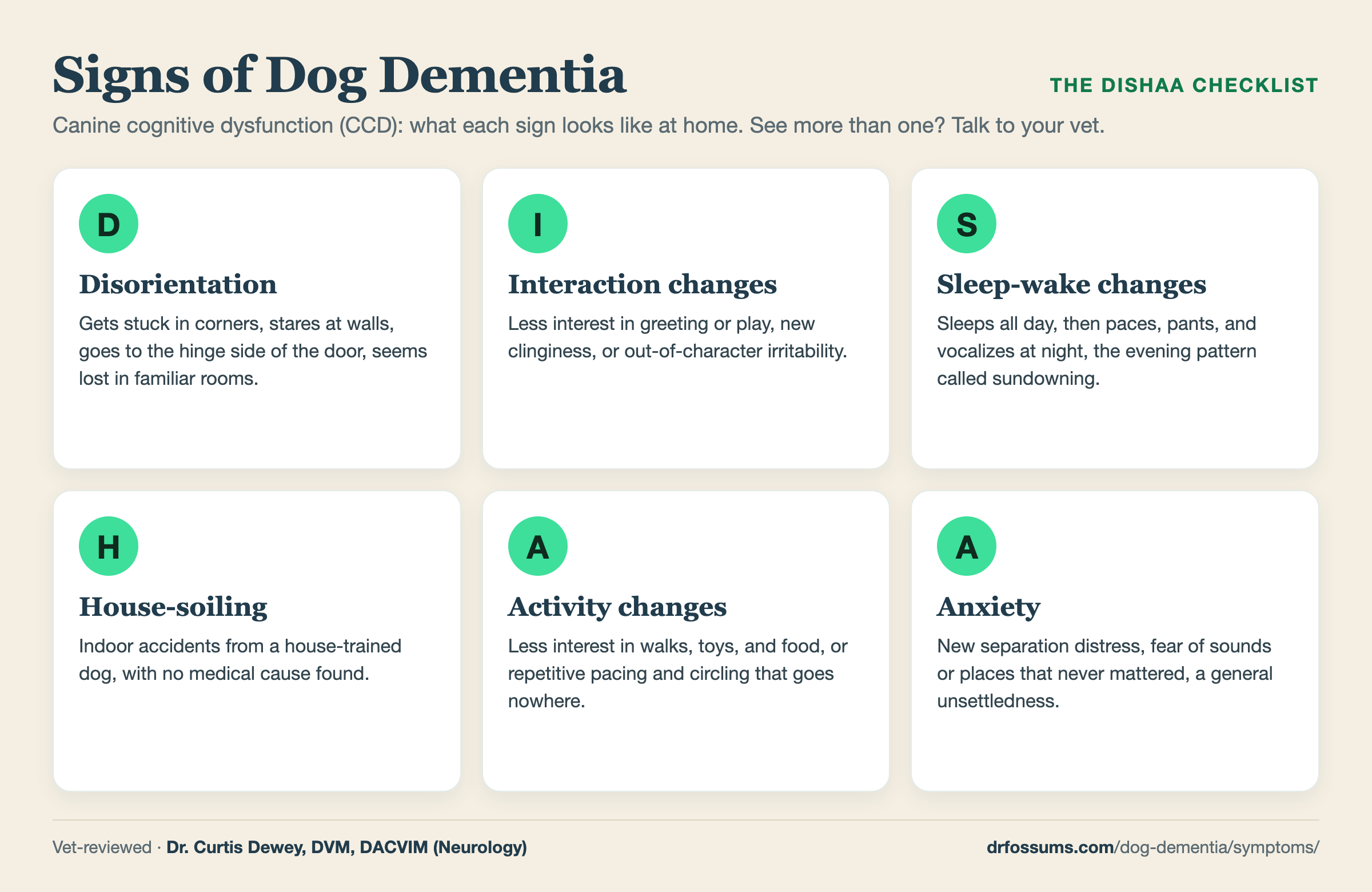
Prefer paper? Download the printable DISHAA checklist (PDF) and mark what you are seeing before your vet visit.
Vets score these same six areas with a screening tool called DISHAA: a total of 4 to 15 points is mild, 16 to 33 is moderate, and above 33 is severe. You can run it at home and bring the score to your appointment. The detail underneath each sign is below.
D – Disorientation
This is the classic one. Your dog stands in the corner facing the wall and does not know how to turn around. He gets “stuck” behind furniture he has walked past a thousand times. He goes to the hinge side of the door instead of the handle side, and waits. He walks into a room and seems to forget why. Outside, he may wander to the wrong part of the yard or stand in the middle of it, lost. Early on this is occasional. Later it happens daily.
I – Interaction changes
The way your dog relates to you and to other pets shifts. Some dogs pull back: less interest in greeting you at the door, less cuddling, less play. Others go the opposite way and become newly clingy and anxious when you are out of sight. A few get irritable or snappy in ways that are out of character, which can be frightening if there are kids or other dogs in the house. Sudden aggression can be a dementia sign too.
Dementia-related aggression usually comes from confusion, fear, or frustration rather than true hostility. A dog who no longer recognizes a familiar person, cannot find food or water, or cannot get outside may growl or snap. Keep everyone safe by giving your dog space, avoiding punishment, and keeping the home and routine calm, familiar, and predictable. Ask your vet to rule out pain or another medical cause, and use gentle daily enrichment, such as short walks or simple puzzle toys, only if it helps your dog stay calm rather than frustrated.
S – Sleep-wake cycle changes
This is the sign owners feel the most, because it costs everyone sleep. Dogs with dementia often flip their schedule. They sleep through the day, then pace, pant, and vocalize at night. The evening and overnight version has a name, sundowning, and it is usually the hardest part of the whole disease. We have a full plan for it here: sundowning in dogs.
H – House-soiling
A dog who was reliably house-trained for years starts having accidents indoors, with no bladder infection or other medical cause behind it. The learned connection between “I need to go” and “I go to the door” breaks down. They may even go right after coming in from outside. This is not spite or stubbornness. The wiring that managed it is failing.
A – Activity changes
Interest drops. Less enthusiasm for walks, toys, food, and the people coming home. Or you see the opposite: repetitive behaviors that lead nowhere, like pacing the same path, circling, or licking the floor. Both directions, withdrawal and repetition, point the same way.
A – Anxiety
New or worse anxiety is common. A dog who was always fine home alone develops separation distress. Sounds, surfaces, or places that never mattered now cause fear. There is a general unsettledness, a sense that your dog cannot quite get comfortable in his own life. Anxiety often tracks with the disorientation: the world stops making sense, and that is scary.
Is it dementia, or just old age?
This is the question every owner asks, and it is the right one. Slowing down with age is normal. A little more sleep, a little less spring in the step, gray on the muzzle, none of that is dementia.
The difference is in the kind of change. Normal aging is physical and gradual: stiffer joints, less stamina, duller hearing. Dementia is cognitive: confusion, lost habits, disrupted sleep, anxiety, and behavior that does not make sense for your dog. If your old dog is simply tired, that is age. If your old dog seems lost, anxious, or “not himself” in his own home, that is worth a vet visit.
One more honest point. Some of these signs can be caused by other things that are treatable, including pain from arthritis, vision or hearing loss, thyroid disease, or a urinary tract infection behind the house-soiling. That is exactly why you do not diagnose this at home.
How do I know for sure?
You confirm dog dementia with your vet, not with a checklist, because the diagnosis is partly about ruling other things out. Two things make that visit far more useful:
First, write down what you have seen. Note which DISHAA signs, how often, and when they started. A short phone video of the night pacing or the wall-staring is worth more than a paragraph of description.
Second, run our quick check before you go. It takes two minutes and gives you and your vet something concrete to work from: take the dog dementia quiz. It is a starting point, not a diagnosis.
When to call your vet
Sooner than you think. The single biggest mistake owners make with dog dementia is waiting, because the changes are easy to explain away as “he is just getting old.” Treatment works best when it starts early, while there is more function to protect.
Call an emergency vet now if a change is sudden or severe, especially collapse, a seizure-like episode, trouble breathing, sudden blindness, inability to stand, severe pain, repeated vomiting, inability to urinate, or confusion that comes on over hours rather than weeks. Dementia develops slowly over months; a fast change points to something else that needs prompt care.
For the slower changes of dementia, call your regular vet if you notice:
- A pattern of two or more DISHAA signs getting worse over weeks
- New aggression, especially around children or other pets
- House-soiling with no obvious cause
Once you have a diagnosis, there is a real plan: medication, diet, enrichment, sleep support, and veterinarian-guided cognitive support to help ease the signs and keep your dog comfortable. We walk through all of it here: how to treat and manage dog dementia.
What to tell your vet
- When it started, and whether it came on suddenly or gradually.
- Whether it is worse at night, after meals, after activity, or during stress.
- Any changes in appetite, thirst, urination, accidents, pain, cough, weakness, or sleep.
- All medications, supplements, CBD, calming products, and any recent medication changes.
- A short video of the behavior, if you can capture it safely.
References and further reading
- Neilson JC, Hart BL, Cliff KD, Ruehl WW. Prevalence of behavioral changes associated with age-related cognitive impairment in dogs. Journal of the American Veterinary Medical Association, 2001. (The study behind the prevalence figures: signs in about a quarter of dogs by 11 to 12 years, and about two-thirds by 15 to 16.)
- 2023 AAHA Senior Care Guidelines for Dogs and Cats. American Animal Hospital Association. (Includes the DISHAA cognitive screening tool developed by veterinary behaviorist Dr. Gary Landsberg.)
- Cornell University Riney Canine Health Center. Cognitive dysfunction in senior dogs.
Frequently asked questions
What are the first signs of dog dementia?
The earliest signs are usually subtle: occasional disorientation (staring at walls, brief confusion in familiar rooms), a slightly off sleep schedule with more night waking, and less interest in greeting you or playing. Most families notice the changed sleep first. A pattern of two or three small changes getting worse over weeks is the time to see your vet.
What are the three stages of dog dementia?
Dog dementia is often described in three broad stages: mild (occasional confusion, slightly disrupted sleep, small changes in interaction), moderate (the signs are now daily and clearly affect normal life, with more night restlessness and house-soiling), and severe (profound disorientation, little recognition, most nights disrupted, and heavy daily care). The stages blur together and progress at different speeds. We walk through what each looks like, and how long they tend to last, in our guide to the stages of dog dementia.
How do I know if my dog has dementia?
Look for the DISHAA pattern: disorientation, changed interactions, disrupted sleep, house-soiling, activity changes, and new anxiety. Write down which signs you see and when they started, and take a short symptom quiz to bring to your vet. Only your vet can confirm it, partly by ruling out other conditions like pain, vision loss, or infection.
What does dog dementia look like day to day?
A dog who gets “stuck” in corners or behind furniture, stares at walls, paces at night, has accidents indoors after years of being house-trained, seems anxious or withdrawn, and forgets familiar routines or commands. Early on it is occasional. Over months it becomes more frequent and obvious.
Is my dog showing signs of dementia or just getting old?
Normal aging is physical and gradual, stiffer joints, less energy, duller hearing. Dementia is cognitive: confusion, lost habits, disrupted sleep, and anxiety that do not fit your dog. If your senior dog seems lost or “not himself” in his own home, rather than just tired, have your vet check for canine cognitive dysfunction.
At what age do dogs start showing dementia symptoms?
Signs usually appear from around age 9 and up, earlier in some large breeds that age faster. Prevalence climbs steeply with age: by one estimate more than a quarter of dogs show at least one sign by 11 to 12, and about two-thirds by 15 to 16.
What causes the symptoms of dog dementia?
The aging brain builds up a protein called beta-amyloid, the same one found in human Alzheimer’s, along with oxidative damage and reduced blood flow. That interferes with how brain cells communicate, which produces the confusion, memory loss, and sleep changes you see. More on the science in our main dog dementia guide.
This guide is educational and is not a substitute for veterinary diagnosis or care. If you are worried about your dog, talk to your veterinarian.