

Senilife for Dogs: Ingredients, Evidence, and How It Compares


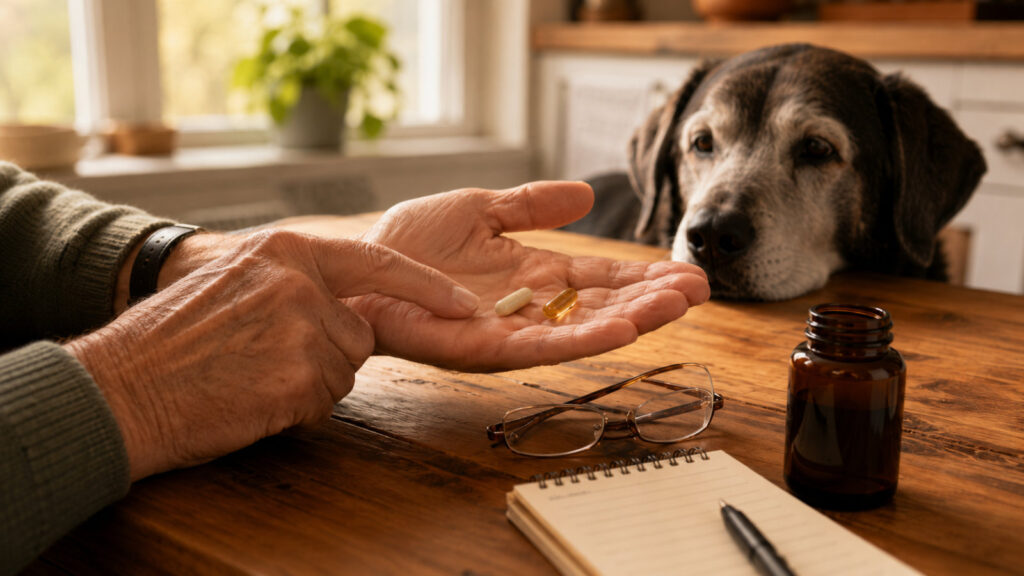
Senilife is a brain-support supplement for senior dogs made by Ceva Animal Health, sold through veterinary clinics and the large pet retailers. It is one of several nutraceuticals owners consider for age-related behavior changes such as disorientation, restless nights, and less interest in the family. This guide covers what is in Senilife, what its published study found, safety notes, and how it compares with other options to discuss with your veterinarian.
Quick answer
Current Senilife contains phosphatidylserine, ginkgo biloba, vitamin B6, vitamin E, and resveratrol. Its published evidence comes from an open-label study of eight dogs that used a four-ingredient formula of phosphatidylserine, ginkgo, vitamin E, and B6, without resveratrol. The study had no placebo group, so the evidence is preliminary. Senilife does not treat or cure dementia and should be considered only after a veterinary examination, as one part of a broader care plan.
What is in Senilife
The roles below describe what each ingredient is intended to do. They are not proof that the ingredient improves dementia in dogs.
| Ingredient | What it is there for |
|---|---|
| Phosphatidylserine | A structural building block of brain cell membranes; the core ingredient in most products in this category |
| Ginkgo biloba | Herbal extract studied for blood flow and cognition; dog-specific evidence is limited |
| Pyridoxine (vitamin B6) | Supports normal neurotransmitter production |
| Vitamin E | Supports normal antioxidant defenses in aging brain tissue |
| Resveratrol | Plant antioxidant, mostly lab-stage evidence |
What the research measured
The published Senilife study was an open-label investigation of eight dogs, with no placebo group. It tested an earlier four-ingredient formula (phosphatidylserine, ginkgo, vitamin E, and B6) that did not include the resveratrol in the current product. The study rated several signs owners recognize – disorientation, changes in sleep and waking, interaction with the family, and house soiling – over the study period. With eight dogs and no placebo group, it cannot show what the product did on its own.
The honest context: this was an eight-dog open-label study with no placebo group. Other studies in the category also have limitations, but their sizes and designs differ – some, like the SAMe and diet trials, used placebo groups and larger numbers. A 2025 systematic review of diets and nutraceuticals for aging dogs concluded the evidence base for the whole class is thin – small numbers and few independent replications. That is not a reason to skip supplements. It is a reason to hold every brand, ours included, to the same standard: know what is inside, give it a fair trial period, and measure what you see instead of hoping.
How Senilife compares
Senilife vs Aktivait
| Senilife (Ceva) | Aktivait (VetPlus) | |
|---|---|---|
| Shared core | Phosphatidylserine plus antioxidant support | |
| Distinct ingredients | Ginkgo, resveratrol, B6, vitamin E | Omega-3s (DHA/EPA), N-acetyl cysteine, alpha-lipoic acid, L-carnitine, CoQ10 |
| Published study | Open-label, eight dogs, no placebo group; several owner-rated signs scored | Randomized, double-blind, placebo-controlled trial of 44 dogs; several behavior areas scored; one trial |
| Worth knowing | Capsule format; give whole by mouth or open the capsule onto food | The dog formula contains alpha-lipoic acid; use only the species-specific product recommended for each pet and never substitute the dog formula for the cat formula |
Senilife vs prescription options
Supplements and medication are different tools. Selegiline is the FDA-approved prescription option for controlling clinical signs associated with canine cognitive dysfunction. A manufacturer-funded 90-day double-blind, placebo-controlled study of diets containing MCTs plus a broader brain-protection nutrient blend provides some of the stronger nutrition data in this field. If signs are affecting daily life, start with the vet conversation rather than the supplement aisle – our medication guide covers what to ask.
Before you start any brain supplement
Confusion, restless nights, and accidents in the house are not always dementia. Pain, thyroid disease, hearing and vision loss, and urinary infections can look identical and are treatable. A vet visit first means the supplement trial you run afterward actually measures the right thing.
References and further reading
- Osella MC, et al. Applied Animal Behaviour Science, 2007 (the eight-dog open-label Senilife study).
- Enhancing cognitive functions in aged dogs and cats: a systematic review of enriched diets and nutraceuticals. GeroScience, 2025 – PMC.
- Updates on Cognitive Dysfunction Syndrome – Today’s Veterinary Practice, 2025
- Pan Y, et al. Frontiers in Nutrition, 2018 (a 90-day double-blind, placebo-controlled diet study in senior dogs).
Frequently asked questions
Does Senilife really work?
The only published study is an open-label trial of eight dogs with no placebo group, which is too small and uncontrolled to say what the product does on its own or whether an individual dog will respond. The honest test is a fair home trial with a before-and-after score, reviewed with your veterinarian.
How long until you know if it is working?
Across this category the practical answer is 60 to 90 days. Score your dog before starting – our free 2-minute cognitive check gives you a number – then re-score. If the score and daily behavior have not changed after the planned trial, ask your veterinarian whether to stop or change course.
Where do you buy Senilife?
Through veterinary clinics and the large pet retailers. If your vet recommends it, they can usually supply it directly.
Are there side effects?
The published study was too small to establish broad safety. Watch for stomach upset when starting anything new, and ask your veterinarian to review the label before starting, especially if your dog takes daily medication.
Is there an alternative to Senilife?
Aktivait is the closest supplement alternative, since both are built on phosphatidylserine, and MCT-enriched diets are the food route. The comparison tables above cover the differences.
Can I give Senilife alongside dementia medication?
Possibly, but only after your veterinarian reviews every medication and supplement together. If you are considering a SAMe-containing product instead, the selegiline combination specifically needs explicit veterinary approval because of a theoretical serotonin concern.
This guide is educational and is not a substitute for veterinary diagnosis or care. If you are worried about your dog, talk to your veterinarian.