

CBD Cat Treats: Do They Work, and Are Drops Better?

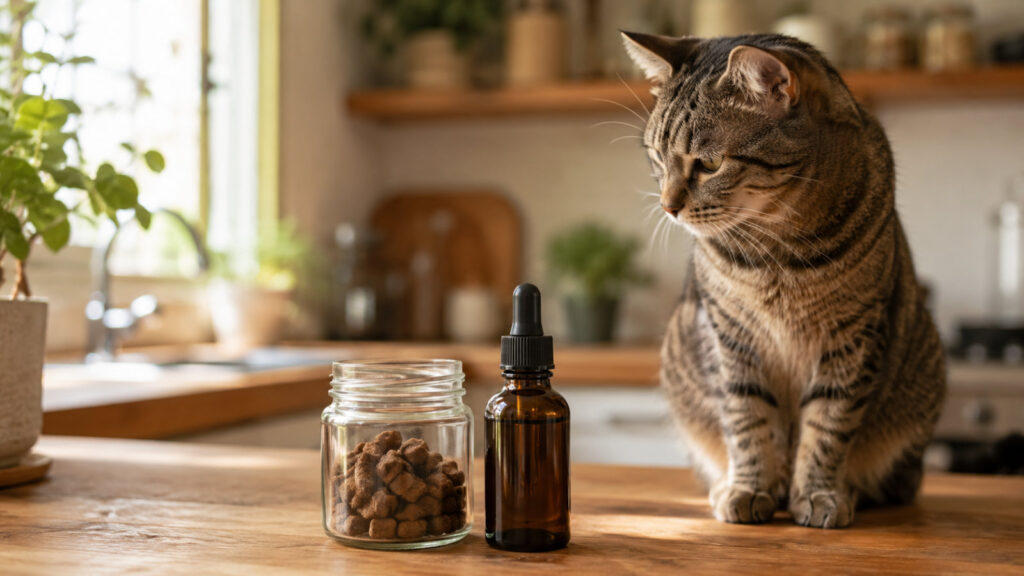
Walk any pet aisle and CBD cat treats look like the easy answer. Whether they are depends less on the idea and more on the label: what the treat actually contains, whether testing backs it up, and whether your cat will eat it day after day. Here is the honest comparison with drops, and how to judge any treat before you pay for it.
Quick answer
CBD is the same molecule whether it is delivered in a treat or a liquid, but products can differ in extract type, ingredients, concentration, testing, and how readily a cat accepts them. Treats can be convenient for cats that eat them consistently. Drops can be mixed into familiar food and offer more measurement flexibility. Whichever format you consider, look for a cat-specific product with clear cannabinoid content and a current, batch-matched certificate of analysis showing no detectable THC.
Do CBD treats work for cats?
A well-made treat can deliver CBD, but there is not enough feline evidence to say that one retail format reliably produces a particular benefit. The practical questions are whether the product states its CBD content, whether current testing supports the label, and whether the cat will eat it consistently.
Manufacturing quality matters as well. The finished treat, not just the hemp ingredient used to make it, should be tested for cannabinoid content.
Treats and cats: what to expect
Cats vary widely in what they will accept. Some readily eat a new treat, while others reject unfamiliar textures or flavors.
Treats also use a fixed-unit format. That is convenient for some owners but offers less measurement flexibility than a liquid. Unless the manufacturer specifically states that a treat can be divided and supports the consistency of divided pieces, do not assume that half a treat contains exactly half of its labeled CBD.
Treats are not inherently better or worse. They are a practical option when the cat accepts them and the product can be verified.
If you do buy treats: what to check
- Clearly stated CBD content. The label should identify how much CBD the product contains. Terms such as “hemp blend” or “hemp oil” do not, by themselves, establish CBD content.
- A current, batch-matched certificate of analysis (COA). The report should come from an independent laboratory and confirm cannabinoid content, including no detectable THC.
- A complete ingredient list. Look for a product formulated for cats and avoid products with unexplained flavor blends or ingredients you cannot identify.
- No concentrated essential oils. Some essential oils can be harmful to cats, depending on the oil, concentration, and exposure.
- A format your cat will accept. Flavor and texture preferences vary, so no flavor can be described as universally appropriate.
Every check above fits on one page. Download the printable buyer’s checklist (PDF) and keep it handy while you shop.
About the treats you will see online
Online listings can make hemp seed oil, hemp extract, and CBD products look interchangeable even though they are not. Hemp seed oil does not establish that a product contains CBD, and some listings do not state any cannabinoid content.
Independent testing has also found substantial label variability. In a 2020 analysis of 29 commercial veterinary hemp products, 27 made a quantitative cannabinoid concentration claim. Only 10 of those 27 were within 10 percent of the claimed concentration, and 2 of the 29 contained no detectable cannabinoids.
We are not going to rank individual products here. The practical rule is simpler: if a listing does not state its CBD content and provide current testing for the applicable product or batch, you cannot verify what you are buying.
A word about gummies
Gummies are primarily formulated for people. Do not give a cat a human CBD gummy, because its cannabinoid content and inactive ingredients may not be appropriate for cats.
A product specifically labeled for cats should still be judged by the same standards as any other format: a complete ingredient list, clearly stated CBD content, and current batch testing.
Why we make drops for cats
We chose a liquid format because it can be mixed into familiar food and measured more flexibly than a fixed-unit treat. Our cat broad-spectrum hemp extract uses a cat-appropriate carrier, lists its ingredients, and has a public batch certificate of analysis.
That is a format decision, not a claim that treats are inferior. A well-made treat may be the easier option for a cat that readily accepts it.
For broader information about product quality and safety considerations, see our cat CBD guide and cat CBD safety page.
When to call your vet
Check with your veterinarian before starting any CBD product, especially if your cat takes medication, since CBD can affect the same liver enzymes many drugs use. Stop and call if you see anything more than mild drowsiness or stomach upset. And if your cat gets into a product containing THC, or any human edible, call your vet or the ASPCA Animal Poison Control Center at (888) 426-4435 right away.
References and further reading
- Wakshlag JJ, et al. Cannabinoid, terpene, and heavy metal analysis of 29 over-the-counter commercial veterinary hemp supplements. Veterinary Medicine: Research and Reports (2020).
- Cornell Riney Canine Health Center. CBD: what you need to know about its uses and efficacy.
- ASPCA. The essentials of essential oils around pets.
Frequently asked questions
Are CBD treats or CBD oil better for cats?
Neither format is universally better. Treats offer a convenient fixed unit when a cat eats them reliably. A liquid offers more measurement flexibility and can be mixed into familiar food, although some cats notice and reject it. Product quality and acceptance matter more than the format alone.
How long does a CBD treat take to work in a cat?
There is not enough feline evidence to give a reliable onset time for retail CBD treats. A CBD treat also should not be presented as a fast-acting sedative or rescue product.
Can I give my cat CBD treats made for dogs?
Do not substitute a dog CBD treat without veterinary review. The cannabinoid content, unit size, and inactive ingredients may differ, and a product formulated for dogs may not be appropriate for a cat.
These statements have not been evaluated by the Food and Drug Administration. This product is not intended to diagnose, treat, cure, or prevent any disease. Educational content, not a substitute for veterinary advice.
This guide is educational and is not a substitute for veterinary diagnosis or care. If you are worried about your pet, talk to your veterinarian.