

Calming CBD for Cats: Travel, Vet Visits and Everyday Stress

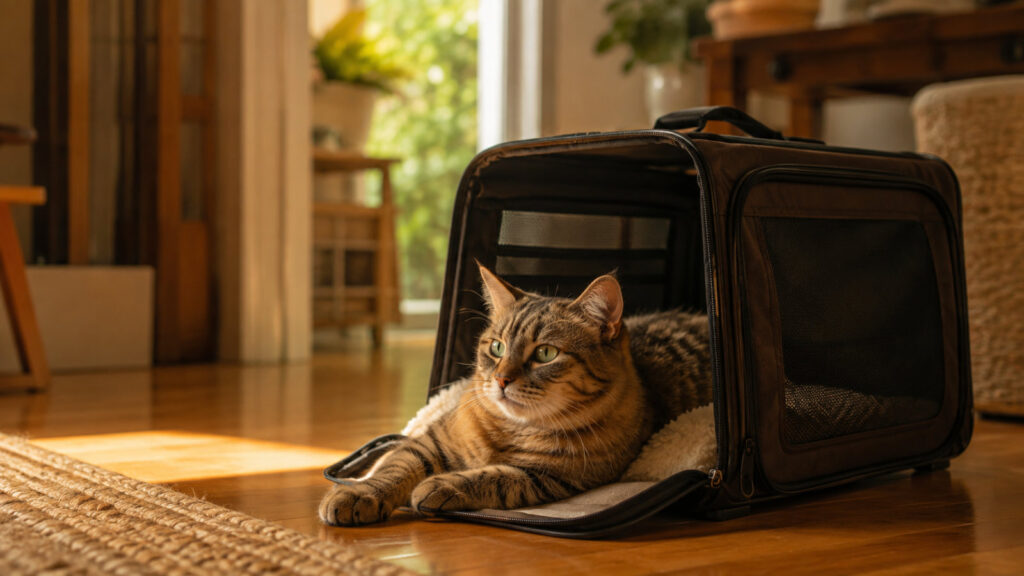
The search that brings most people here usually happens the night before a car ride, a vet visit, or a move, hoping a supplement can calm the trip. The honest answer starts earlier than that. Here is what actually helps a stressed cat, scenario by scenario, and where CBD genuinely fits.
Quick answer
CBD should not be presented as a reliable sedative you give immediately before a trip. If a cat is already panicking in the carrier, an over-the-counter supplement is unlikely to resolve severe fear in that moment.
The useful tools are preparation: gradual carrier conditioning, a calm travel routine, and, for cats with severe fear, a conversation with the veterinarian about prescription pre-visit medication. If CBD is considered at all, its role is consistent background support assessed over weeks, not a same-day rescue product.
Why CBD is not event medication
A common mistake is treating CBD like a same-day event medication. Current feline evidence does not support presenting it as a reliable acute sedative or rescue product.
In one controlled study involving carrier travel and meeting a novel person in an unfamiliar setting, a single CBD administration produced no overall measurable effect on feline stress responses. That does not rule out every possible formulation or pattern of use, but it does not support CBD as reliable event medication.
If CBD is used at all, its possible role is background support assessed over consistent daily use. Event-specific fear should be addressed through preparation and, when needed, medication prescribed by a veterinarian.
Unexpected sleepiness, loss of coordination, or other marked behavior changes after a cannabinoid product should not be interpreted as proof that it is “working.” Stop and contact a veterinarian.
Scenario by scenario
The following steps focus first on the cat’s environment and preparation. Prescription medication is a separate veterinary decision for cats whose fear remains severe.
The carrier
Carrier fear often reflects unfamiliarity or a previous negative association. When practical, keep the carrier accessible between trips with familiar bedding inside. Use treats, meals, or play to build a positive association, and progress gradually from entering the carrier to brief door closures.
Covering the carrier with a towel can reduce visual stimulation. A feline facial pheromone spray may help some cats, although the evidence is mixed. Apply it to bedding before the cat enters and follow the product’s label directions.
Car rides
Secure the carrier on the floor behind the front seats or according to the carrier manufacturer’s restraint instructions. Keep the car quiet and at a comfortable temperature, and do not open the carrier in an unsecured vehicle or outdoor area.
Short practice drives that end at home can help make the car less predictive of a clinic visit. If your cat drools, vomits, or appears nauseated during travel, ask your veterinarian about meal timing and treatment for motion sickness rather than withholding food on your own.
Vet visits
Ask your clinic about quieter appointment times and whether you can wait in the car until an examination room is ready. If your cat remains severely fearful despite carrier conditioning, ask the veterinarian about pre-visit medication.
Gabapentin is a prescription medication commonly used by veterinarians before travel and examinations to reduce stress in some cats. Whether it is appropriate, and how it should be used, is a decision for the prescribing veterinarian.
Moving house
Moving combines several common feline stressors: unfamiliar people, boxes, noise, and disruption of the cat’s territory and routine. Set up one quiet room that moves last and gets unpacked first, with familiar bedding, litter, and hiding spots. Keep feeding times fixed while everything else changes. Expect a settling period of days to weeks in the new home. Keep the cat securely indoors during the transition, make sure identification and microchip information are current, and take extra precautions around doors and movers.
A new kitten, cat, or dog
Introductions should proceed gradually: separate spaces first, followed by scent exchange, controlled visual contact, and supervised time together only after both animals appear comfortable.
If either cat eats less, hides more, overgrooms, or develops other persistent behavior changes, slow the process and contact your veterinarian because those signs can reflect stress or illness. Preserve familiar routines and provide enough separate food, water, litter, resting, and hiding resources.
Fireworks, storms, and loud nights
Use a quiet interior or curtained room, steady background noise, and accessible covered hiding places. Let the cat choose whether to remain hidden, and do not pull the cat out for comfort. These environmental measures are the main tools available during the event itself.
The whole plan above fits on one page. Download the printable Carrier and Travel Calm Plan (PDF) and stick it on the fridge before the next trip.
Multi-cat tension
Cats on edge with each other, including redirected aggression, are a resources problem before they are a supplement problem. Give each cat its own litter box, food and water, and resting spots, add high perches and quiet hiding places, and consider a feline pheromone diffuser. Some owners then add daily CBD as background support and judge the household over one to two weeks.
A naturally high-strung or rescued cat
A cat who startles easily benefits most from a predictable routine and safe places to retreat. If you try CBD, give it daily at consistent times and expect nothing dramatic: any change is subtle, and a drowsy cat means the dose is too high.
Where CBD fits
Across these scenarios, CBD should be described only as possible background support, not as event medication. If it is considered, it should be evaluated through consistent daily use over weeks rather than timed around a particular trip or stressful event.
A 26-week study found that one THC-free CBD distillate was well tolerated in healthy cats. That study did not test travel fear, fireworks, moving stress, or this product, so it supports a limited tolerability statement rather than a claim that CBD improves these situations.
If your cat takes medication or has an ongoing health condition, discuss CBD with the veterinarian before using it. See our cat CBD safety page for additional cautions.
Giving it, and what to expect
The easiest way to give a cat CBD oil is mixed into a small amount of strong-smelling wet food or a lickable treat, at the same times each day. For a one-off stressor such as the carrier or a vet visit, keep expectations modest: in the one controlled cat study (Weller et al., 2024), a single dose before carrier travel and meeting a stranger in an unfamiliar place had no overall measurable effect, so preparation does the work for the event itself. For ongoing tension, owners give it daily and judge over one to two weeks. If your cat seems sedated, lower the dose. CBD does not work for every cat and it is not a substitute for fixing the cause.
When to call your vet
Talk to your veterinarian if your cat’s fear stays severe despite carrier conditioning, since pre-visit medication is their call. Any sudden behavior change, new hiding, or appetite loss deserves a medical check rather than a calming plan, because those signs can mean illness. If your cat seems unexpectedly sleepy or wobbly after any supplement, stop it and call. And if your cat may have gotten into THC, marijuana, or edibles, call your vet or the ASPCA Animal Poison Control Center at (888) 426-4435 right away.
References and further reading
- Weller JE, et al. Investigating the effect a single dose of cannabidiol has on measures of stress in cats when being transported in a carrier and meeting a novel person in an unfamiliar environment. Frontiers in Veterinary Science (2024).
- Coltherd JC, et al. Healthy cats tolerate long-term daily feeding of cannabidiol. Frontiers in Veterinary Science (2024).
- van Haaften KA, et al. Effects of a single preappointment dose of gabapentin on signs of stress in cats during transportation and veterinary examination. JAVMA (2017).
- Shu H, Gu X. Effect of a synthetic feline facial pheromone product on stress during transport in domestic cats: a randomised controlled pilot study. Journal of Feline Medicine and Surgery (2021).
- Frank D, et al. Systematic review of the use of pheromones for treatment of undesirable behavior in cats and dogs. JAVMA (2010).
- AAFP client brochure: Getting your cat to the veterinarian (PDF).
- AAFP guide: How to introduce a new cat to other cats in your home (PDF).
Frequently asked questions
What can I give my cat for travel stress?
For travel, focus on carrier conditioning, secure and quiet transportation, and a predictable routine. A feline pheromone spray may help some cats but is not a substitute for conditioning. If fear is severe, ask your veterinarian about prescription pre-visit medication. CBD should not be presented as something given once to sedate a cat before travel.
How long before travel should I give my cat CBD?
CBD should not be timed as a pre-travel sedative. There is no established feline pre-event timing that makes it a reliable travel medication. Any background use should be assessed as consistent daily support over weeks, not around the departure time. Discuss severe travel fear with your veterinarian.
Do pheromone diffusers and sprays actually help?
Pheromone products may help some cats, but the research is mixed and not every cat responds. They are best treated as an optional addition to carrier conditioning and environmental preparation, not as a cure for fear. Follow the label directions and allow sprayed bedding to air before placing it in the carrier.
Should I ask my vet about gabapentin or just use CBD?
Gabapentin is a prescription medication veterinarians commonly use for some cats before travel or an examination. CBD is not a substitute for that role and should not be presented as an acute sedative. Because CBD may interact with medications, discuss any combination with the prescribing veterinarian.
Does CBD calm cats?
CBD may support a normal calm state in some cats; it is not a sedative and not a treatment for any disorder, results vary, and feline research is small.
Will CBD sedate my cat?
It should not at the right dose. Heavy drowsiness means the dose is too high; lower it. The goal is calm, not sedation.
Is it safe to give a cat CBD every day?
Daily use is common and generally well tolerated. Check with your vet first if your cat takes other medication.
These statements have not been evaluated by the Food and Drug Administration. This product is not intended to diagnose, treat, cure, or prevent any disease. Educational content, not a substitute for veterinary advice.
This guide is educational and is not a substitute for veterinary diagnosis or care. If you are worried about your pet, talk to your veterinarian.