

Foxtails in Dogs: The One-Way Seed That Never Backs Out

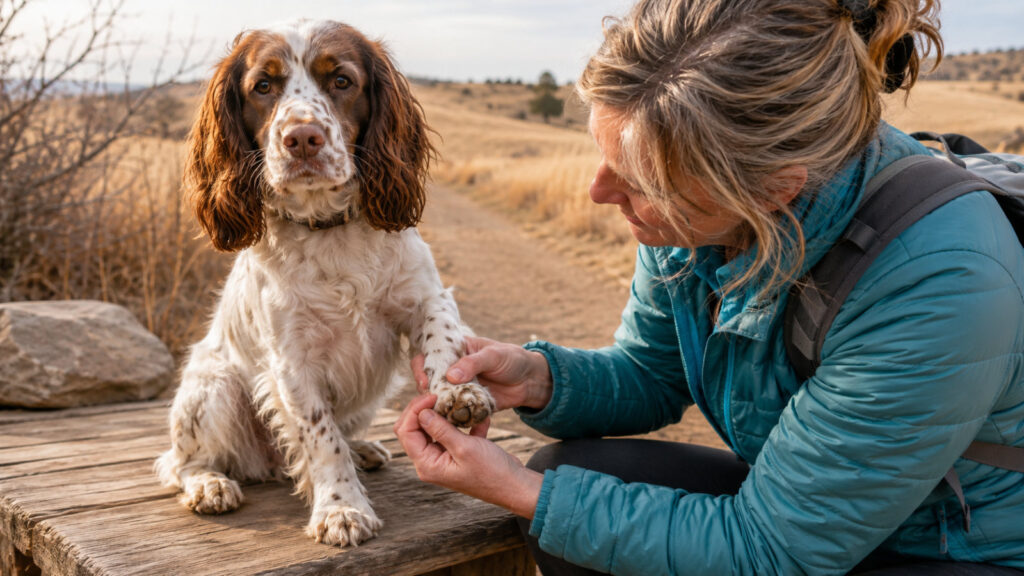
Every dry summer, a grass seed engineered like a harpoon meets a species engineered to run through grass, and veterinary clinics across the West fill with the results. The foxtail awn, the bristled seed head of wild barley and its cousins, has a design feature every dog owner in foxtail country must understand: it only moves one direction. Barbed like a fishhook, it works inward with every muscle twitch (through skin, up noses, down ears), and it does not back out, dissolve, or give up. Here is the field guide: the by-location signs, the after-walk ritual that catches them early, and the honest line between home tweezers and the vet’s tools.
Quick answer
Foxtails are barbed grass awns (peak season: late spring through summer’s dry months, worst in the western US) that attach to fur and migrate one-way into bodies.
The by-location signatures. PAWS: sudden licking of one spot between toes, a swelling or small draining hole (the classic). NOSE: violent, sudden sneezing fits on a walk, sometimes with a nose-paw or blood drops. EARS: abrupt head-shaking and tilt after field time. EYES: sudden squinting and pawing.
A visible, superficial awn in fur or between toes: remove it with tweezers. Anything embedded, draining, or in nose-ear-eye territory: vet, promptly, because awns migrate (they have been found in lungs and spines), and the digging-at-home attempt usually pushes them deeper. The prevention: the sixty-second after-walk check ritual, every dry-grass walk.
The one-way physics (why this seed earns a whole page)
A foxtail awn is a masterpiece of hostile botany: a pointed tip backed by rows of microscopic rearward barbs, built to drill seed into soil, and equally effective drilling into dogs. Every movement of the surrounding tissue ratchets it forward; nothing ratchets it back.
That is why the foxtail story escalates the way it does: the seed that started between two toes on Tuesday is under the skin by Thursday and tracking up the leg by the weekend, leaving a draining tract behind it. The documented worst cases (awns recovered from lungs, abdomens, even spinal tissue) all began somewhere ordinary.
It is also why the body cannot resolve a foxtail: unlike a splinter that festers its way out, the awn’s barbs defeat expulsion, and infection travels with it as a package deal. The entire game is early: on the fur = a flick; between the toes = tweezers; under the skin = the vet’s game, and the sooner the shorter the track.
The by-location field guide
- Paws, the classic: sudden focused licking at one spot (the between-toes webbing above all), a red swelling, then the tell: a small draining hole where the awn went in. Early = visible-and-tweezable; established = the vet exploring a tract. Our paw-obsession pages cover the look-alikes: foxtail licking is one-spot-sudden versus yeast’s whole-paw-chronic.
- Nose, the dramatic: an abrupt, violent sneezing fit mid-walk, sometimes twenty sneezes in a row, pawing at the muzzle, occasionally blood drops. The sneezing may settle while the awn remains; sudden-onset field sneezing earns the vet scope even after it quiets. (Chronic-sneeze and reverse-sneeze intents belong to their own pages; this is the sudden-fit-in-dry-grass story.)
- Ears, the head-shaker: sudden shaking, tilt, and ear-pawing after field time, the same signals as ear infections with a faster onset and a season. Do not flush or dig: the otoscope look comes first, because pushing an awn against an eardrum is the avoidable disaster.
- Eyes, the squinter: sudden one-eye squinting, tearing, pawing after grass time; an awn under a lid scratches the cornea by the hour: same-day, per the eye rules.
- The hidden entries: armpits, groin, and under collars (fur mats hide travelers), and, male-dog owners note, the sheath. Any sudden-onset draining sore in a field dog in season reads foxtail-until-proven-otherwise.
The ritual, the removal line, and the season strategy
The sixty-second after-walk check
This is the tool that prevents most of this page. Toes spread one by one (webbing especially), then ears (flap and visible canal), eyes, nose, armpits, groin, and a full-hand fur sweep with special attention to feathered legs, tails, and long coats; awns still IN fur are a flick to remove.
The removal line
A visible awn sitting superficially (in fur, or its back half still proud between toes) comes out with fingers or tweezers, pulled straight; anything embedded flush, anything already swollen or draining, and everything in nose-ear-eye territory belongs to the vet, because home digging in those locations reliably drives the awn deeper and the visit later.
The season strategy
Know the enemy grass (the bristled wheat-like heads lining every dry path), route around the worst patches in high summer, keep field dogs’ feet and feathering trimmed in season, consider the field-dog vest-and-boots gear category for the serious hiker, and mow the home yard’s foxtail patches before they seed. In foxtail country, the ritual is simply part of owning a dog: sixty seconds against a seed that never backs out.
See the vet promptly (same-day where flagged) if
Sudden violent sneezing fits after field time (even if they settle), ear shaking-and-tilt with a field history, any eye squinting (same-day, corneas are on the clock), a swelling or draining hole anywhere, an awn embedded flush you cannot fully grasp, or a season sore that heals and reopens: that is the migrating-tract signature, and it needs exploration, not another week.
References and further reading
Frequently asked questions
How do I know if my dog has a foxtail in his paw?
Sudden, focused licking at one spot (classically the webbing between toes), then a red swelling, then a small draining hole. Spread the toes in good light: a visible back end can be tweezed straight out; a flush or draining site is the vet’s exploration, promptly.
Can a foxtail come out by itself?
Very rarely: the rearward barbs are built to defeat expulsion, and every tissue movement tends to ratchet it inward instead. Foxtails are the rare foreign body with a one-way arrow, which is why early removal is everything and watchful waiting always loses.
What happens if a foxtail is not removed?
It migrates, leaving an infected draining tract, and in the documented worst cases reaching chests, abdomens, and spines from ordinary starting points. The heals-and-reopens sore is the migration signature; the fix is exploration and removal, and sooner is dramatically simpler.
Where are foxtails a problem, and when?
Worst across the western US (California famously), and present through much of the country’s dry-grass zones; the season runs late spring through the dry months as seed heads mature and detach. In season and territory, the after-walk check is simply part of the walk.
Educational content, not a substitute for veterinary advice. If your dog seems unwell, contact your veterinarian.
This guide is educational and is not a substitute for veterinary diagnosis or care. If your dog's skin looks infected or painful, talk to your veterinarian.