

Why Does My Dog Keep Licking Their Paws?

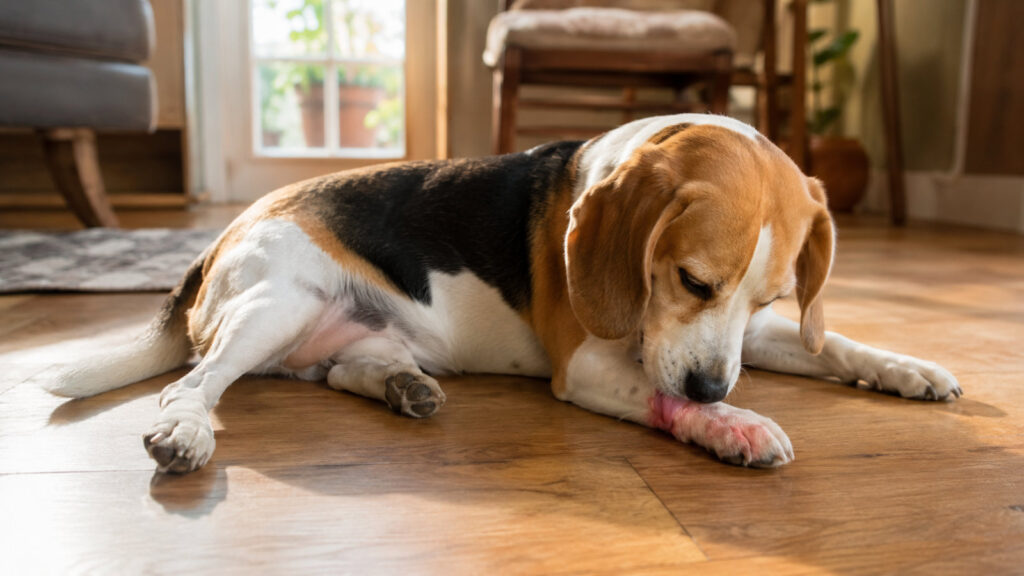
Some paw licking is just a dog being a dog – a quick clean after a walk, a minute of grooming before sleep. The licking that brings people to this page is different: constant, focused, wet-sounding, often at night, sometimes to the point of pink skin or rusty-stained fur. That kind of licking always has a reason, and the pattern of it – which paws, what the fur looks like, what it smells like – points to the reason surprisingly well.
Quick answer
All four paws usually means allergy – environmental allergy shows up in dogs as paw licking more than almost any other sign. One paw means look at that paw: a cut, a torn nail, a grass awn, a sting, or pain in the joint above it. A musty corn-chip smell means yeast has joined in, and rust-colored fur is saliva staining – proof the licking has been going on a while. Constant licking, limping, swelling, or broken skin deserve a vet visit.
Read the pattern: one paw or all four?
| What you see | What it usually means | What to do |
|---|---|---|
| All four paws, on and off for weeks | Allergy – environmental (pollen, grass, dust mites) or food; paws are the classic canine allergy site | The allergy workup: see the diagnostic ladder |
| One paw, started suddenly | Something may be in or on that paw: a cut pad, torn nail, thorn or grass awn between the toes, insect sting – or pain above the paw | Inspect in good light, toe by toe and between the pads; if you find nothing and licking continues, the vet looks deeper |
| Musty “corn chip” smell, greasy or brown-tinged skin | Yeast (Malassezia) overgrowth – usually secondary to allergy plus moisture from the licking itself | Veterinary confirmation is quick (tape cytology); yeast needs treatment or the cycle continues |
| Rust or pink-brown stained fur on the paws | Saliva staining – a timestamp proving weeks of licking, most visible on light coats | Not a disease itself, but evidence the cause needs finding |
| Licking mostly when alone or at night, paws look normal | Habit, boredom, or stress-related licking – real, but a diagnosis of exclusion | Rule out the medical causes first; then address the routine, enrichment, and stress |
Why allergies pick the paws
In people, hay fever hits the nose; in dogs, the same allergies hit the skin – and paws bear the brunt because they touch everything. Grass, pollen, dust, cleaning products, lawn treatments, and de-icing salts all meet the paw first. Add the moisture of licking and you get a damaged skin barrier where yeast and bacteria – normal residents in small numbers – overgrow and add their own itch. That is how “a bit of paw licking in spring” becomes year-round misery: allergy starts it, infection sustains it. Breaking the cycle usually needs both treated, which is why a quick look under the microscope at the vet is worth so much more than another month of watching.
The five-minute paw check to do tonight
Good light, treats nearby, one paw at a time: spread the toes and look between them, check each pad’s surface for cuts or embedded debris, look at the nails and nail beds (a cracked nail is easy to miss and very lickable), feel for heat or swelling, and sniff – you now know what the corn-chip smell means. Compare left to right; asymmetry is information. If your dog suddenly will not tolerate a paw being handled that they normally allow, treat that as a finding in itself and mention it to your vet – pain licking is real, and in an older dog a persistently licked wrist or ankle can be about the joint, not the skin. Our senior readers may recognize this pattern from joint-comfort territory.
When it is the mind, not the skin
Boredom and stress-related licking exist – some dogs self-soothe with repetitive licking the way people bite nails. But it is a diagnosis of exclusion: most “behavioral” paw licking turns out to be allergy on closer inspection, and getting that wrong means months of training a dog out of an itch they cannot help. If the medical ladder comes up genuinely clean, then look at exercise, enrichment, alone-time routines, and stress – our guide to supporting calm behavior covers the honest options.
On soothing products: because dogs ingest what is on their paws, ask your veterinarian before applying anything topical there, including our own Anti-itch & Soothing Spray – placement matters more on paws than anywhere else.
When paw licking needs your veterinarian
Book a visit for licking that continues past a week or two, any limping or swelling, redness or broken skin between the toes, the musty smell of yeast, or a dog who guards the paw from your hands. Go promptly if a paw is hot, swollen, or clearly painful – and remember that grass awns migrate: a seed that entered between the toes does not stay put.
References and further reading
- Merck Veterinary Manual. Atopic dermatitis in dogs.
- PetMD. Yeast infections in dogs: ears, skin, and paws.
- American Kennel Club. Why is my dog so itchy?
Frequently asked questions
Why does my dog lick their paws constantly?
The most common cause is allergy – environmental or food – which in dogs shows up in the paws more than anywhere else. One suddenly-licked paw suggests an injury or something stuck; a musty smell means yeast has joined in. If food is the suspect, the diet routes that actually work are compared in our dog food for allergies guide.
Why do my dog’s paws smell like corn chips?
That musty Frito smell is Malassezia yeast overgrowth, common on paws that stay moist from licking. It is easy for a vet to confirm and it needs treating, or it keeps the lick-itch cycle going.
Why are my dog’s paws turning rusty red-brown?
That is saliva staining on the fur from chronic licking – visible proof of how long it has been going on, especially on light coats. The stain is harmless; the licking behind it needs a cause found.
Is paw licking ever just behavioral?
Yes, but it is the last explanation to accept, not the first. Most “habit” licking turns out to be allergy or low-grade pain. Rule the medical causes out first, then work on boredom, routine, and stress.
Educational content, not a substitute for veterinary advice. If your dog seems unwell, contact your veterinarian.
This guide is educational and is not a substitute for veterinary diagnosis or care. If your dog's skin looks infected or painful, talk to your veterinarian.