

Functional Mushrooms for Dogs: The Honest Science Guide

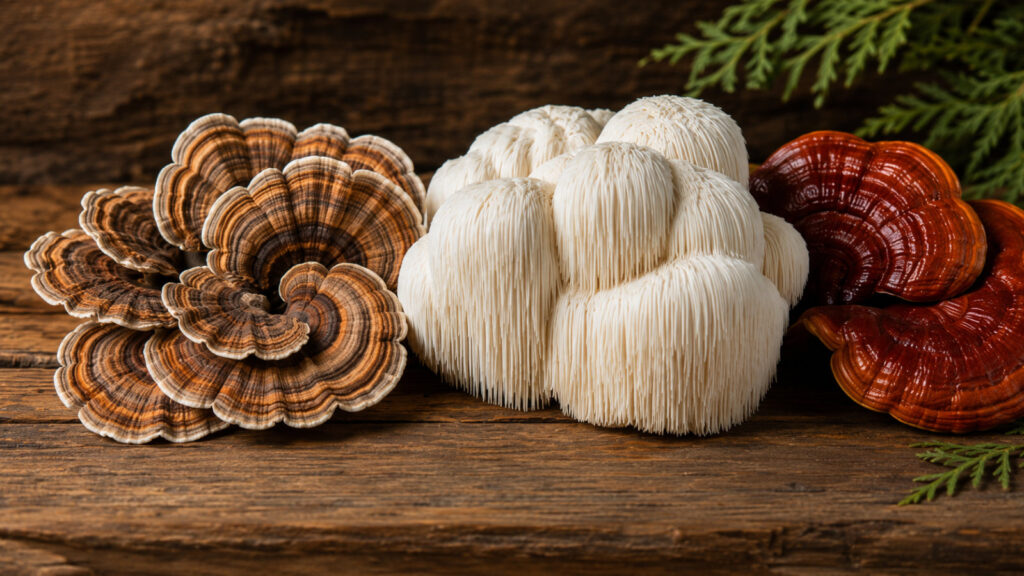
Functional mushrooms have arrived in dog care the way CBD did a few years ago – big claims, crowded shelves, and a real body of science somewhere underneath the marketing. This guide is the somewhere-underneath: what turkey tail, lion’s mane, and reishi actually are, what studies exist in dogs (fewer than the labels imply, more than skeptics assume), and how to read a supplement label so you get mushroom instead of grain flour. It is written to earn trust with the honest version rather than borrow it with the hyped one.
Quick answer
Functional mushrooms are fungi (turkey tail, lion’s mane, reishi lead the list) whose beta-glucans and other compounds are studied for immune, cognitive, and inflammatory support.
The dog-specific evidence is real but thin. A small University of Pennsylvania pilot reported a longer median survival than historical estimates in its five-dog highest-dose group, but it had no concurrent control and a larger 2022 trial did not confirm a benefit. A 2024 randomized trial found a modest immune effect from reishi in healthy beagles. Lion’s mane has strong laboratory and human data but no controlled canine trial yet.
Quality varies enormously – look for fruiting-body extracts with a stated beta-glucan percentage and a certificate of analysis. These are supplements: they support normal function and never replace veterinary care.
The big three: which one for what you want to support
Most owners arrive with a goal in mind rather than a mushroom. Here is the honest map from what you want to support to the mushroom whose evidence is most relevant, and to the guide that lays it out in full. None of these treats disease; each supports normal function, and a dog with a diagnosis needs its veterinary team first.
| What you want to support | Where to start | The evidence, honestly | Full guide |
|---|---|---|---|
| Everyday immune function, especially in a senior dog | Turkey tail (Trametes versicolor) | A small 2012 canine pilot at Penn Vet, not confirmed by a larger 2022 trial; decades of human research on its extracts | The full story, study and all |
| Immune balance and a normal inflammatory response | Reishi (Ganoderma lucidum) | A 2024 randomized beagle study showed a modest immune effect (supplier-funded) | The immune-balance case |
| Cognitive function in an aging dog | Lion’s mane (Hericium erinaceus) | Compelling lab mechanism (nerve growth factor) and human data; no controlled canine trial yet | The aging-brain case |
Two more stops as you narrow it down: everything else on a blend label (cordyceps, chaga, maitake, shiitake) gets an honest read in the roundup, and when you are ready to judge a product, the five label checks do the work. Quality and transparency matter at least as much as which species you pick: a fruiting-body extract with a stated beta-glucan percentage is far easier to evaluate than a blend that hides its fungal fractions, beta-glucan content, and per-species amounts.
Chaga, cordyceps, maitake, and shiitake round out most blends; their dog-specific evidence is thinner still, which is why the big three carry this guide – and why a blend’s value mostly rides on how much of the big three it actually contains.
How to read a mushroom label – the quality trap
The largest quality gap in this category is invisible on the front of the package: fruiting body versus mycelium on grain. The fruiting body is the mushroom itself – where beta-glucans and signature compounds concentrate. Mycelium-on-grain products grow the fungal root-web on rice or oats and grind up the whole block; testing by the mushroom-supply company NAMMEX reports such products can run from roughly a third to over half starch, with low beta-glucan content.
Neither the word “mycelium” nor the starch appears in the marketing. The label habits that protect you:
- “Fruiting body extract” stated plainly – and be wary when the ingredient line says “mycelial biomass” or lists rice or oats.
- A standardized beta-glucan percentage (for example, “standardized to 30 percent beta-glucans”) – the number that starch-heavy products cannot print. “Polysaccharides” is not the same claim; starch is a polysaccharide too.
- A certificate of analysis (COA) you can actually see – identity, potency, contaminants. The habit our CBD guides taught applies unchanged here.
- Species by Latin name and per-serving amounts – a “proprietary blend” that will not say how much turkey tail is in it has answered your question already.
Safety, and where the vet comes in
The supplement species are unrelated to toxic wild mushrooms, but dog-specific safety evidence is limited and product-specific. Mild gastrointestinal signs have been reported with some products, though their frequency is not well established across species and extracts.
The genuine caution list: dogs on immunosuppressive medications or anticoagulants, and dogs with autoimmune conditions – immune-active supplements deserve a vet conversation in exactly those cases, and any supplement joins the full medication inventory you keep with your clinic.
Two boundaries we hold and say out loud: functional mushrooms support normal function – they are not treatments for cancer, dementia, or allergies, and any product page whispering otherwise is selling past the science. And the backyard question is a different page entirely: wild mushrooms are their own safety topic with an emergency lane.
Talk to your veterinarian first if
Your dog takes immunosuppressive drugs or blood thinners, has an autoimmune condition, is being treated for cancer (supplements can interact with treatment plans – oncologists want the full list), or is a puppy, pregnant, or seriously ill. And nothing on this page changes the rule that new symptoms get diagnosed before they get supplemented.
References and further reading
- Brown DC, Reetz J (2012). Single agent polysaccharopeptide delays metastases and improves survival in naturally occurring hemangiosarcoma (PMC) – the 2012 pilot.
- Gedney A, et al. (2022). Evaluation of Coriolus versicolor polysaccharopeptide alone or with doxorubicin for canine splenic hemangiosarcoma (Veterinary and Comparative Oncology) – the larger 2022 follow-up that did not confirm a survival benefit.
- Kayser E, et al. (2024). Functional properties of Ganoderma lucidum supplementation in canine nutrition (Journal of Animal Science) – the 40-beagle reishi study (funded by the ingredient supplier).
- PetMD. Medicinal mushrooms for dogs.
Frequently asked questions
Do mushroom supplements for dogs actually work?
The real tiering: turkey tail has a small 2012 canine trial (encouraging, but not confirmed by a larger 2022 study); reishi has a 2024 randomized canine immune study (a modest, supplier-funded result); lion’s mane has a strong laboratory mechanism and human data but no controlled dog trial yet. “Early and mixed” is the accurate phrase – which is more than most supplement categories can say, and less than most mushroom marketing does.
What is the best mushroom for dogs?
It depends on the job: turkey tail for immune support (the most veterinary-studied), lion’s mane for aging-brain support, reishi for immune balance and normal inflammatory response. Quality beats species choice: a fruiting-body extract with stated beta-glucans of any of the three outranks a starch-heavy blend of all of them.
Are mushroom supplements safe for dogs?
Dog-specific safety evidence is limited and product-specific, though the supplement species are unrelated to toxic wild mushrooms. Mild gastrointestinal signs have been reported with some products, but their frequency is not well established across species and extracts. The vet-first list: immunosuppressive or anticoagulant medications, autoimmune disease, active cancer treatment.
Can I just feed my dog mushrooms from the store instead?
Plain cooked button mushrooms are safe food, but they are not a supplement – the studied extracts concentrate compounds far beyond dinner-mushroom levels. The kitchen question (and the wild-mushroom emergency) lives in our can-dogs-eat guide.
How much mushroom supplement should I give my dog?
There is no universal mushroom dose for dogs, and no dose transfers across species, extracts, or products – the amounts used in studies are research figures, not label instructions. Follow the exact dog-specific product label, dosed for your dog’s weight (beta-glucan percentage helps you evaluate composition, but it is not a dosing system), and ask your veterinarian about the exact product, especially if your dog takes medication or has a medical condition.
Educational content, not a substitute for veterinary advice. These statements have not been evaluated by the FDA. This product is not intended to diagnose, treat, cure, or prevent any disease.
This guide is educational and is not a substitute for veterinary diagnosis or care. If you are worried about your dog, talk to your veterinarian.