

Fruiting Body vs Mycelium: The Mushroom Quality Debate, Settled Honestly

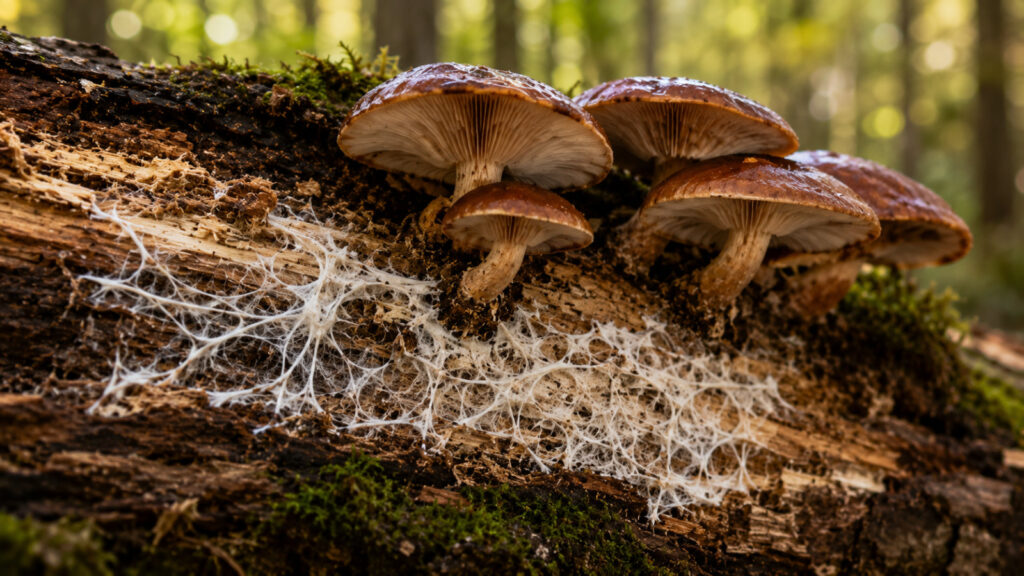
Every guide on this site keeps pointing at one label distinction (fruiting body versus mycelium) and it deserves its own full explanation, because it is the single largest quality gap in the mushroom supplement world and it is nearly invisible to shoppers. It is also not quite the simple good-versus-bad story the supplement wars suggest. Here is the whole picture: what each part of the fungus is, why grain-grown products have a starch problem, and the one legitimate case where mycelium earns its place.
Quick answer
The fruiting body is the mushroom itself, the part that grows above the surface, where beta-glucans and signature compounds (triterpenes in reishi, hericenones in lion’s mane) concentrate.
Mycelium is the fungal root network, and commercial mycelium products are typically grown on grain and harvested grain-and-all. Testing by the mushroom-supply company NAMMEX reports such products can run from roughly a third to over half starch, with modest fungal content.
Both parts of the fungus contain beta-glucans, but for most purposes fruiting-body extracts with stated beta-glucan percentages are the quality standard. The honest exception: certain compounds (lion’s mane erinacines) come from mycelium, so a transparent product combining both by design, with numbers, can be legitimate. The tell is always disclosure.
What each part actually is
A fungus lives mostly out of sight: the mycelium is its working body – a web of threads spreading through wood or soil, digesting, absorbing, doing the organism’s daily living. The fruiting body is its reproductive act – the mushroom that emerges to release spores, built dense with the structural beta-glucans and defensive compounds the supplement world is after.
Traditional medicine used fruiting bodies for a straightforward reason: that is where the chemistry concentrates, and that is the part you can gather. Nothing about mycelium is inherently fake (it is half the organism) but what matters for a supplement is what ends up in the jar, and that is where commercial reality enters.
The grain problem, explained fairly
Growing fruiting bodies takes months and skill. Growing mycelium on sterilized grain takes weeks and a warehouse – the fungal threads colonize a block of rice or oats, and here is the pivotal detail: in these solid-state products the mycelium is not separated from the grain, so the whole block is dried and milled together. (Liquid-fermentation methods that recover mycelium without the grain do exist – more on that below.)
The product is honestly labeled “mycelial biomass” – and it is biomass in the fullest sense: industry testing of grain-grown products (notably by NAMMEX, using the McCleary-Draga enzymatic beta-glucan assay published in the Journal of AOAC International) has repeatedly found high starch, often a third or more, with beta-glucan levels a fraction of fruiting-body extracts.
In those tested products, the dog (or human) is getting largely grain with a modest fungal fraction. None of this is illegal or even deceptive by the letter – the deception is structural: the front label says mushroom, the price says mushroom, and only the ingredient line (“myceliated rice,” “full-spectrum mycelial biomass”) and the missing beta-glucan number tell the truth. That is why our choosing guide makes this check one and two of five.
The honest case for mycelium – and what transparency looks like
Now the part one-sided takedowns skip: some meaningful compounds live in the mycelium, not the fruiting body. The clearest example is lion’s mane, whose erinacines (the nerve-growth-factor stimulators studied most intensely) are produced in the mycelium, while its hericenones come from the fruiting body – which is why thoughtfully built lion’s mane products sometimes include both fractions by explicit design.
Some research-grade extracts also use pure liquid-fermented mycelium with the grain substrate removed – a legitimate, more expensive technique that bears no resemblance to milled grain blocks. The dividing line, then, is not fruiting-body-good-mycelium-bad. It is engineered versus accidental, disclosed versus hidden: a label that says which fractions, grown how, standardized to what beta-glucan percentage, has earned trust whichever parts it uses. A label hiding behind “proprietary full-spectrum biomass” has answered the question by refusing it.
The practical takeaway
Flip the jar. Fruiting-body extract plus a beta-glucan number = the two core quality signals – confirm them alongside species by name, per-serving milligrams, and a current batch-matched COA. Mycelium disclosed with purpose and numbers (an erinacine-bearing lion’s mane fraction, a grain-free fermentation) = legitimate, judge normally. “Mycelial biomass” with rice or oats in the ingredients and no beta-glucan figure = an unanswered transparency question at mushroom prices – keep walking. And every standing veterinary caution from the main guide applies to all of them equally.
References and further reading
- Gaia Herbs. Mushroom mycelium vs fruiting bodies.
- North Spore. The mycelium vs fruiting body dispute.
- NAMMEX. Redefining medicinal mushrooms – industry beta-glucan and starch testing of fruiting-body vs mycelium-on-grain products.
- McCleary BV, Draga A. (2016). Measurement of beta-glucan in mushrooms and mycelial products. Journal of AOAC International 99(2):364-373.
Frequently asked questions
Is fruiting body or mycelium better in a mushroom supplement?
For beta-glucans and most signature compounds: fruiting body, clearly – and grain-grown mycelium products carry a real starch problem. The one exception is purpose-built mycelium fractions (lion’s mane erinacines, grain-free fermentations) disclosed plainly on the label. Engineered and numbered beats hidden, whichever fraction.
How can I tell if a supplement is mycelium on grain?
Ingredient line: “mycelial biomass,” “myceliated rice or oats,” or grains listed outright – paired with the absence of a standardized beta-glucan percentage. The front label will not tell you; the panel always does.
Why are fruiting-body supplements more expensive?
Months of cultivation versus weeks of grain colonization – real mushroom farming costs more than warehouse biomass. The per-jar premium usually vanishes per-beta-glucan: the cheaper jar delivering a fraction of the active content is the expensive one.
Does the starch in mycelium products hurt dogs?
Usually it is a potency and value problem rather than a safety one: you paid mushroom prices for grain flour, and your dog receives a fraction of the intended support. That said, the grain can still matter for a dog with dietary restrictions or a sensitive gut.
Educational content, not a substitute for veterinary advice. These statements have not been evaluated by the FDA. This product is not intended to diagnose, treat, cure, or prevent any disease.
This guide is educational and is not a substitute for veterinary diagnosis or care. If you are worried about your dog, talk to your veterinarian.