

Sensitive Stomach Cat Food: What Fixes It, What Just Says It

“Sensitive stomach” has no standardized nutrient profile or defined formulation behind it: it is a manufacturer’s phrase for a bundle of gentle-leaning choices, and it may or may not address what is actually wrong with your cat’s mornings. The productive move is to run the differential first: the common culprits are eating speed, food transitions, hairballs, and true ingredient intolerance, and only the last is really about the recipe. This guide runs that list in order, then explains what the gentle formulas genuinely offer and when a vomiting cat has left label territory altogether.
Quick answer
Before blaming the recipe, check the common culprits in order: eating too fast (food reappears whole minutes after meals; slow-feeder bowls and smaller portions usually help), a food switch made too quickly (fixed by gradual transitions), hairballs (tubular, fur-packed; grooming helps most), and only then genuine ingredient intolerance, where a deliberate food trial earns a fair few weeks, knowing a true food reaction is confirmed only by a stricter vet-guided elimination protocol.
“Sensitive stomach” on a label typically means gentler formulation choices, a single or simplified protein source, moderate fat, added soluble fiber or probiotics, not medicine. Occasional isolated vomiting happens to healthy cats; frequent vomiting, or vomiting with weight loss, appetite loss, lethargy, or diarrhea, is a vet workup, not a shopping trip.
First, the impostors
Start with speed. A cat that bolts its meal, especially in a multi-cat home where speed means keeping your dinner, swallows air and overloads a small stomach, and the meal comes back up whole, undigested, within minutes. No recipe fixes competitive eating; structure does.
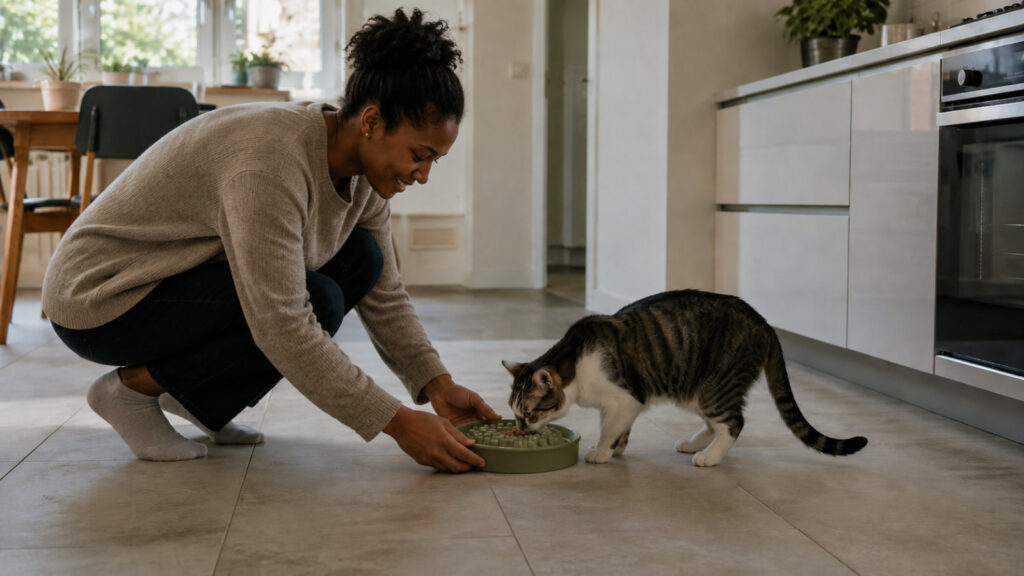
The fixes: smaller, more frequent portions, a slow-feeder or puzzle bowl that turns gulping into working, meals served apart from rival cats, and for the flat-faced breeds a shallow wide dish. If the “vomiting” is prompt, effortless, and looks like the food went in, start here. And if effortless bring-ups keep recurring despite the fixes, tell your vet: recurrent regurgitation can also signal an esophagus problem, and that distinction is theirs to make.
The second impostor is the fast transition. Abrupt menu changes can upset feline digestion, vomiting or diarrhea that gets blamed on the new food’s quality rather than the change’s speed.
The repair is the boring one: any food change, including a change to a sensitive-stomach formula, runs over seven to ten days, new food gradually replacing old, and slower still for cats with a track record. The third impostor is the hairball, which arrives as a tubular, fur-packed package rather than a meal, and peaks in shedding seasons and in long-haired cats. Brushing helps most reliably; fiber-based hairball diets help some cats, with mixed evidence; and persistent hairballs belong in a vet conversation rather than a run of food switches. Frequent hairballs, though, have their own message, and it is not always benign; mention them at the next vet visit.
What the label actually promises
Once the impostors are ruled out, the gentle formulas get their turn, and it helps to know what you are buying. “Sensitive stomach” recipes usually make some of these choices: a simplified ingredient list built around one animal protein, so there is less to react to and less to suspect; moderate fat, because rich meals sit heavier; highly digestible ingredients; added soluble fiber to steady the gut; and often a probiotic strain.
These are sensible, gentle engineering choices, and for a cat with genuine mild intolerance they can make mornings quieter. What they are not is a diagnosis, a treatment for disease, or a regulated category with a standard behind the words, two bags saying “sensitive” can be built quite differently, which is why the trial below matters more than the front of the bag.
Running a fair food trial
- Change one variable. New food, ten-day transition, and everything else held steady: same treats or none, no table scraps, no second experiments running.
- Give it three to four weeks. Guts settle on their own schedule; judging a food in five days mostly measures the transition, not the recipe.
- Keep a boring log. Dates of incidents, what came up or out, appetite, energy. Patterns beat impressions, and the log is gold if the vet enters the story.
- Judge on the trend. Fewer incidents, better stool, steady weight means the formula earned its place. No change means stop cycling bags, that is the signal to look deeper, not wider.
If a simplified diet clearly helps and signs return with the old food, diet composition may be involved, worth telling your vet, because the formal version of that experiment, a strict elimination trial using a novel protein your cat has never eaten, or a hydrolyzed protein broken into smaller fragments to reduce the chance of immune recognition, is the diagnostic tool for true food allergy, and it is run with veterinary guidance rather than store rotation. The pointers for chronic disease feeding live in our upset stomach guide.
When it was never the label’s job
Some vomiting needs a medical workup rather than another food change, and recognizing it early matters most. Frequency is the first line: an isolated, unremarkable vomit now and then happens to healthy cats, but vomiting multiple times a week, or daily, is a patient, not a picky eater. Company is the second: vomiting that travels with weight loss, shrinking appetite, lethargy, diarrhea, or increased thirst points at conditions, inflammatory bowel disease, pancreatitis, hyperthyroidism in seniors, kidney disease, that no sensitive formula touches.
And the acute red flags end all label talk immediately: repeated vomiting in a single day, blood, a cat who also will not eat (the not-eating clock runs concurrently), retching without producing, or a distressed, hiding cat. Those are same-day calls. The gentle formulas are for gentle problems; part of their honest use is knowing when the problem is not gentle.
References and further reading
- Cornell University, Cornell Feline Health Center. Food allergies.
- Merck Veterinary Manual. Disorders of the stomach and intestines in cats.
Frequently asked questions
What actually counts as “too much” vomiting?
There is no universal safe frequency. Recurrent vomiting, even weeks apart, deserves a veterinary conversation when it persists, accelerates, or travels with any other change, weight, appetite, energy, stool, or thirst.
Is grain-free the answer for a sensitive stomach?
Usually not. Documented feline food reactions point mostly at proteins, beef, fish, chicken among the usual suspects, not grains. “Grain-free” changes the carbohydrate source, not the part most sensitive cats are sensitive to; a simplified or novel protein is the more rational lever.
Wet or dry for a sensitive stomach?
Wet food adds moisture and suits small frequent meals, and some cats do better on it; others do equally well on dry sensitive formulas. Ingredient profile, digestibility, and what your cat reliably eats matter more than format, and a fed cat outranks a theoretical ideal.
Do probiotics help cats?
Feline-specific evidence is modest but growing, and quality varies widely between products. As a low-risk adjunct alongside good feeding structure, a vet-recommended feline probiotic is reasonable; as the main treatment for real disease, it is miscast.
Could it be the bowl, the place, or the schedule rather than the food?
Yes. Eating speed, competition, stress, and gulped meals after long gaps can all produce the same signs without the recipe being at fault. The structural fixes, slow bowls, smaller meals, separate stations, regular times, are free, fast, and the correct first experiment.
This guide is educational and is not a substitute for veterinary diagnosis or care. Diet changes for a cat with a medical condition belong in a conversation with your veterinarian.