

Feeding a Cat With an Upset Stomach: The Feline Bland Diet, Done Right

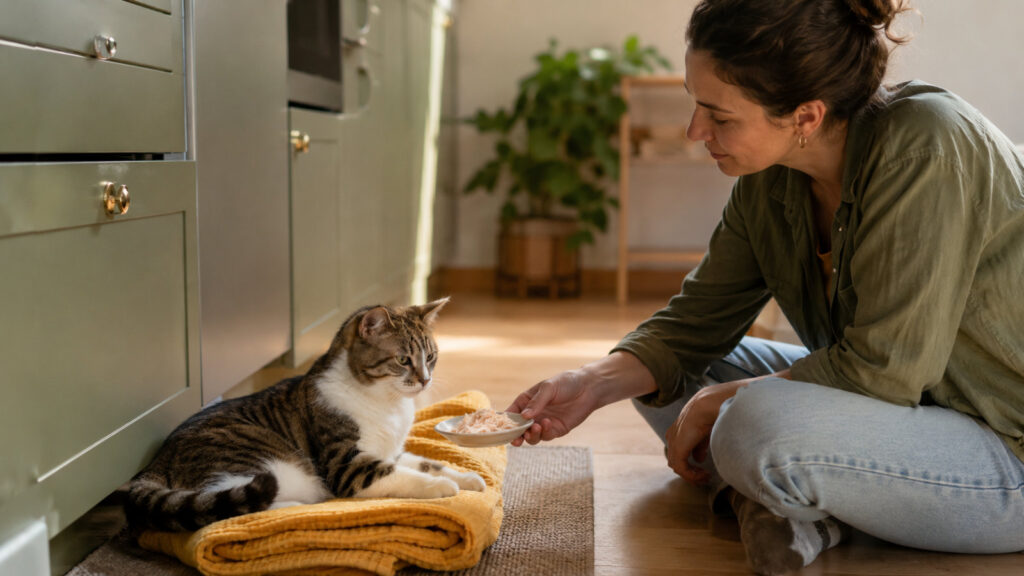
The advice dog owners know by heart, a brief fast and then chicken and rice, is exactly the advice that must not be transferred to cats. Prolonged inadequate intake can set off hepatic lipidosis, a potentially fatal fatty-liver syndrome, which is why deliberate fasting is never a home treatment for a cat. Feline upset stomachs have their own rulebook, gentler, sooner to call the vet, and never built on deliberate starvation. This guide covers the feline bland diet properly: what to serve through vomiting and diarrhea, the constipation counterpart, the reintroduction, and the situations where home feeding is the wrong plan entirely.
Quick answer
Do not deliberately fast a cat unless your veterinarian specifically instructs it. Keep small, gentle amounts of food available, cats that stop eating risk hepatic lipidosis, a dangerous fatty-liver complication, so the feline plan keeps food moving, and a cat that refuses those offerings starts the not-eating clock. The feline bland diet is small, frequent servings of a single gentle protein, plain cooked chicken or turkey with no seasoning, skin, or bones, or a veterinary gastrointestinal formula, plus constant fresh water.
Improvement should show within a day or two, then the normal diet returns gradually over several days. Call the vet the same day for repeated vomiting, frequent or watery diarrhea, blood in either direction, reduced drinking, pain, lethargy, a cat who also stops eating, or any kitten, senior, or chronically ill cat, their reserves are too small for home timelines; mild loose stool lingering past about forty-eight hours also deserves a call.
The two feline rules that change everything
Rule one: the fast is off the table. In dogs, resting the gut briefly is commonly recommended. A cat’s metabolism responds to fasting by streaming stored fat into the liver, and, as the Cornell Feline Health Center describes, the resulting fatty-liver syndrome is almost always set off by exactly this kind of not-eating episode, on top of whatever started it. So feline gut care walks a narrower path: gentle food, small and often, unless a veterinarian explicitly directs a brief withhold under supervision.
Rule two: avoid creating a food aversion while your cat is nauseous. A nauseous cat that is pushed toward any food, especially a brand-new one, can build a lasting aversion to it, cats blame the menu, not the illness. The practical translations: never force-feed into nausea, offer rather than press, and avoid introducing a favorite food or a therapeutic diet you may need long-term on a sick day, because the illness can become attached to that food. If a cat refuses even gentle offerings, that is not a cue to push harder; that is the not-eating clock starting, and it runs concurrently with everything on this page.
The feline bland diet, precisely
- The food: plain cooked chicken or turkey, boiled or baked, no skin, no bones, no salt, seasoning, onion, or garlic, shredded fine or mashed with a little of its own cooking water. A complete veterinary gastrointestinal diet is the better choice when more than a very brief bridge is needed, because unlike plain poultry it is complete nutrition; your veterinarian picks the right formulation for the problem.
- The portions: smaller meals, more often, are easier on an irritated stomach than two large ones. Watch the day’s total: a cat taking only token amounts is not actually eating, and that is a call to your veterinarian, not a longer wait.
- The water: always available, refreshed often; the cooking-water mash and wet textures move fluid in with the food, which matters double during diarrhea.
- What stays out: rice earns its keep in the dog version, and most cats neither need nor want it, a spoonful of plain rice mixed in is acceptable, never the point; skip dairy, tuna-in-oil, fatty scraps, and anything seasoned.
- The duration: this is a bridge, not a diet, a day or two of visible improvement, then the return trip below. Plain chicken is not complete nutrition, and cats tolerate incomplete feeding badly; more than a few days needs a vet’s plan and a complete GI formula.
Coming back to normal food
When vomiting has stopped and stools are reforming, rebuild over roughly three to five days: bland servings with a little of the regular food mixed in, the ratio shifting meal by meal toward normal, at the same small-and-frequent rhythm before returning to the usual schedule. If vomiting returns during the ramp, call your veterinarian the same day; if the only change is slightly softer stool in a cat who otherwise feels well, slow the transition a step rather than forcing the next one. Cats whose upsets keep recurring on ordinary food afterward are having a different conversation, the food-choice conversation, which is our sensitive stomach guide.
The constipation counterpart
The same aisle, the opposite problem: a cat straining in the box, passing hard dry pellets, or visiting without producing. Feeding-side help is real but modest, and it starts with water: wet-forward meals, extra water stations, a fountain, broth-style toppers if your vet approves. Constipation itself has many possible causes, and persistent or painful straining needs veterinary evaluation rather than a longer home experiment.
Fiber helps some cats, a vet-suggested amount of plain canned pumpkin is the classic gentle version, and psyllium-based approaches exist under veterinary guidance, but fiber without water can worsen the jam. Two hard boundaries: a cat straining with no urine is a different emergency entirely, the blocked-cat scenario in our urinary guide, do not guess between them, and a constipated cat that is also vomiting, refusing food, or clearly uncomfortable is a same-day vet visit, because obstipation, severe constipation where stool is stuck and cannot pass, is treated in the clinic, not the kitchen.
When home feeding is the wrong plan
The bland diet’s job is small: bridge a mild, self-limiting upset in an otherwise healthy adult cat. It is the wrong tool, immediately, when the picture includes repeated vomiting within a day, vomiting that returns for more than a day or two, frequent or watery diarrhea, or milder diarrhea lasting beyond about forty-eight hours, blood in vomit or stool, dark tarry stool, a cat who stops eating or drinking, lethargy or hiding, a swollen or painful belly, retching that produces nothing, or a known swallower of string and small objects.
It is also the wrong tool for kittens, seniors, diabetics, and cats with kidney or other chronic disease, small reserves and standing prescriptions both outrank home timelines. And chronic patterns, weeks of intermittent vomiting or diarrhea, weight drifting down, deserve a workup rather than a rotation of gentle menus: conditions like inflammatory bowel disease and pancreatitis are managed with veterinary diet strategies, sometimes hydrolyzed diets, protein broken into very small fragments, or novel-protein diets built on a protein the cat has not eaten before, chosen and supervised for the purpose, and the sooner they are named, the better the feeding plan around them works.
References and further reading
- Cornell University, Cornell Feline Health Center. Hepatic lipidosis.
- Merck Veterinary Manual. Disorders of the stomach and intestines in cats.
Frequently asked questions
Can I fast my cat for 12 or 24 hours like a dog?
No. Deliberate fasting is a veterinary decision, never a home treatment; the liver complication above is the reason. Keep small, gentle amounts available unless your vet directs otherwise, and if the cat will not take them, call, that is the not-eating problem now.
Is chicken and rice good for cats?
The chicken half, yes: plain, cooked, unseasoned. The rice half is a dog convention cats mostly do not need; a small amount mixed in is harmless. Cats are obligate carnivores, meaning they depend on nutrients from animal tissue, and the gentle protein is the part doing the work.
What can I give a cat for vomiting over the counter?
Nothing self-prescribed, please. Human anti-nausea, anti-diarrhea, and antacid medicines range from useless to genuinely dangerous in cats, and effective feline anti-nausea medication exists on prescription. At home, follow the feeding pattern on this page; medication for vomiting comes from your veterinarian.
My cat vomits, then eats normally and seems fine. Bland diet anyway?
An isolated vomit with a normal cat behind it usually needs nothing but observation and maybe one gentle meal. The bland protocol earns its keep when upset persists across meals; the pattern-watching rules live in the sensitive stomach guide.
How much pumpkin for a constipated cat?
Ask your vet for the amount for your cat’s size, small spoonfuls of plain canned pumpkin, never pie filling, is the usual shape, and treat it as an adjunct: the water work matters more, and a genuinely blocked or miserable cat needs the clinic, not the pantry.
This guide is educational and is not a substitute for veterinary diagnosis or care. Diet changes for a cat with a medical condition belong in a conversation with your veterinarian.