

Diabetic Cat Food: The Low-Carb Logic, Honestly Told

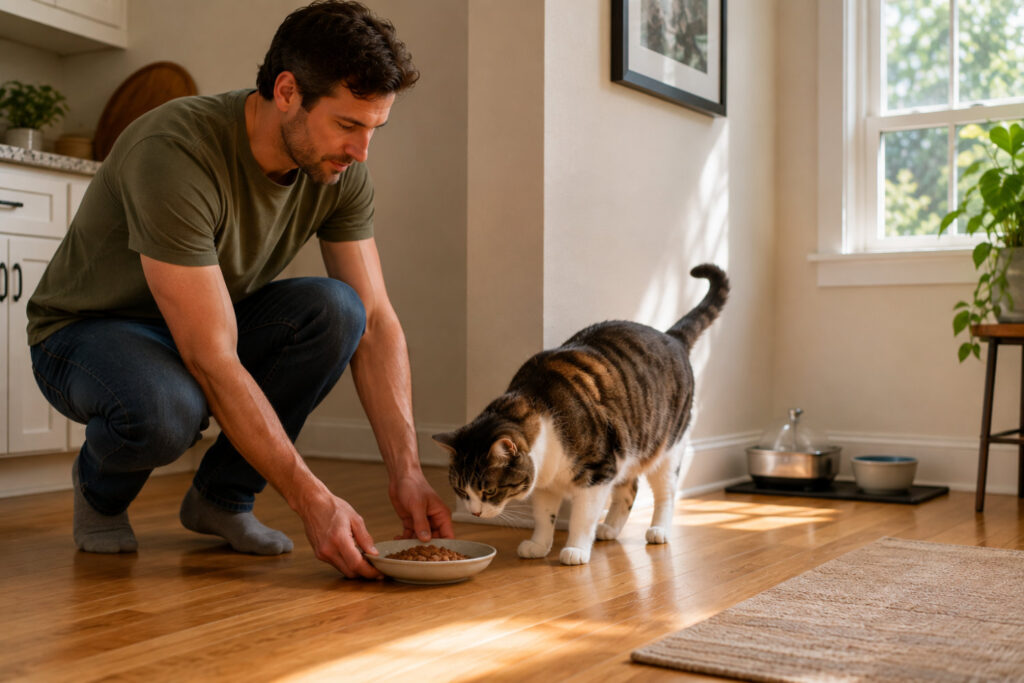
A feline diabetes diagnosis lands hard, and then a genuinely hopeful fact follows: cats are unusual patients: feline diabetes sometimes goes into remission, meaning blood sugar stays controlled without ongoing diabetes medication, and diet is a documented part of what tilts those odds. The veterinary literature reports published remission rates of up to 68 percent under early, tightly managed protocols, and low-carbohydrate feeding is one of the levers. This guide explains the low-carb logic, gives you the practical version, wet food, carb math, the multi-cat problem, and states plainly the safety rule that sits above all of it.
Quick answer
Most diabetic cats ultimately benefit from a lower-carbohydrate, high-protein feeding plan, usually built on wet food, because it asks the least of a broken glucose system, and published veterinary work associates low-carb feeding with roughly fourfold better odds of remission, meaning blood sugar controlled without ongoing diabetes medication. The timing depends on the treatment: cats starting an oral SGLT2-inhibitor medication, a diabetes drug that removes excess sugar through the urine, follow a different, vet-directed diet transition, so the food never changes on your own schedule. Remission is real and worth pursuing, and it is a possibility, not a promise; it happens most in newly diagnosed cats managed early and tightly with their vets.
The rule that outranks everything: never change a diabetic cat’s food, or skip insulin, or adjust doses, without your veterinary team, because diet changes shift insulin needs, and an unchanged dose on a lower-carb day can drive blood sugar dangerously low. Diet and dosing move together, on veterinary supervision, or not at all.
Why carbohydrates are the lever
Cats are obligate carnivores, animals whose metabolism depends on nutrients from animal tissue, built for prey: protein and fat in, steady glucose made internally on demand. Dietary carbohydrate, most of it arriving via dry food’s starch, hands a diabetic cat exactly the challenge its insulin system can no longer meet: a post-meal glucose surge. Cut the carbs, and the surges flatten; the pancreas’s remaining function and the injected insulin both face an easier job. That is the entire low-carb logic, and it is why the practical prescription so often reads simply “wet food”: typical canned foods run far lower in carbohydrate than typical kibbles, whose starch is partly structural, needed to make kibble hold shape.
The remission numbers, told straight
Here is what the veterinary literature supports, without inflation. Management goals in feline diabetes shifted years ago from mere control to pursuing remission, a cat whose blood sugar stays controlled, for months or sometimes permanently, without ongoing insulin or oral glucose-lowering medication. Published remission rates range widely and reach as high as 68 percent in some reports, generally in newly diagnosed cats under early, intensive management.
Within that work, feeding low-carbohydrate food is associated with about four times better odds of achieving remission than higher-carb feeding. And the honest asterisks: those figures come from specific protocols rather than from diet alone, some cats, for reasons individual to them, do better on a high-fiber approach instead, and a cat can do everything right and still need treatment for life. Remission is a goal worth pursuing, never a result that is owed.
The practical diet, without perfectionism
- Wet food first. Most complete wet foods are naturally lower-carb than kibble, and the moisture is its own gift. Therapeutic diabetic formulas are available; many cats also do well on ordinary low-carb complete wet foods their vet approves.
- Ask the manufacturer for carb numbers. Labels do not print carbohydrate directly, and back-calculating it from label minimums and maximums is rough at best. Ask the maker for current carbohydrate data and let your vet interpret it, the same honesty rule as our phosphorus guide.
- Feed to the schedule your vet sets. Keep food and daily intake consistent at the calorie target your veterinary team sets; our feeding guide can translate that vet-set target into cans and cups, though its calculator never sets a diabetic cat’s number. Treats stay inside the plan; consistency is half the treatment.
- Mind the weight in both directions. Many diabetics start overweight, and gradual loss improves insulin response, the safe method in our weight guide; unplanned loss, though, is a report-to-the-vet signal, not a win.
- If kibble must stay, say it out loud. Some cats refuse wet food, and a fed diabetic beats a fasting one every time. Low-carb dry options and dose adjustments exist; the plan bends to the cat.
The safety rule, spelled out
Diet and insulin are one system. Move one side and the other side’s number changes, which is why the transition to lower-carb food is a supervised event: your veterinary team monitors glucose through the change and adjusts treatment as needed, because yesterday’s treatment against today’s flatter glucose can overshoot into hypoglycemia, weakness, wobbling, seizures, an emergency with a countdown. The same logic covers the happy direction: cats heading toward remission need treatment adjusted on data, not guesses. So the operating rule for owners is short: change nothing unilaterally. Not the food, not the dose, not the schedule. Bring the idea to the veterinary team, and let the two dials move together.
The multi-cat problem
The hardest version of feline diabetes is often logistical: one diabetic in a three-cat home, where the patient grazes the housemates’ kibble and the housemates raid the therapeutic wet food. Solve it structurally, not through vigilance. Scheduled meals for everyone, no standing buffet, which most housemates adjust to within a grumbling week. Separate rooms or stations out of sight lines at mealtimes. And for the stubborn cases, a microchip feeder that opens only for the tagged cat, so the diabetic’s diet, and everyone else’s, enforces itself. It is worth the setup: for a diabetic cat, an open communal bowl quietly undermines the controlled intake the treatment depends on, which is why physical separation beats constant supervision.
Newly diagnosed: the first weeks, calmly
The opening stretch is the steepest, so here is the honest shape of it. Expect a settling-in period of vet visits and glucose checks while dose and diet find each other; expect injection technique to become easier with practice, and lean on your veterinary team if you or your cat struggle with the routine.
And expect the two treatment paths in feline diabetes, insulin and an oral SGLT2-inhibitor option for selected newly diagnosed cats, to be your vet’s choice to make, matched to your cat’s labs and health, not a menu you order from. Your levers are the ones this page covers, the food, the schedule, the log, the separations, and early, closely monitored management is what the remission statistics describe, even though excellent care cannot guarantee the outcome.
References and further reading
- Kirk CA. Feline diabetes mellitus: low carbohydrates versus high fiber? Veterinary Clinics of North America: Small Animal Practice, 2006.
- U.S. Food and Drug Administration. FDA approves first oral treatment for cats with diabetes mellitus (fda.gov).
- Cornell University, Cornell Feline Health Center. Feline diabetes.
Frequently asked questions
Can diet alone cure my cat’s diabetes?
Occasionally remission follows a diet change alone, but that is not an expected treatment path, and it is never a home experiment, because undertreated diabetes does silent damage. A newly diagnosed cat needs a veterinary treatment plan and glucose monitoring from the start, with diet as a partner to treatment and remission as a possible, monitored outcome.
What carbohydrate level counts as low?
Veterinary guidance sets the target as a low share of calories from carbohydrate, and formulas vary: many canned foods run lower than dry foods, but no format guarantees the number. Use the manufacturer’s carbohydrate data and your veterinary team’s target for the specific foods.
Is prescription diabetic food required?
Not always. Therapeutic formulas are purpose-built and take the guesswork out; vet-approved ordinary low-carb wet foods can also serve, and cost or pickiness sometimes decides. What is required is that the choice is made with your vet, because food interacts with the whole treatment plan, including the insulin dose when insulin is in use.
How soon after a diet change could remission happen?
When it happens, it is typically within the first months of tight management, which is why the early period is worked so intensively. In an insulin-treated cat, falling insulin requirements can prompt your vet to assess for remission, which is confirmed only when normal blood sugar persists without diabetes medication; every step on that path is the vet’s move, never a home shortcut.
My diabetic cat stopped eating today. What do I do?
Call your vet now. If your cat uses insulin, do not give the usual dose on an empty stomach without veterinary instruction; the usual dose in a cat that is not eating can drive blood sugar dangerously low. If your cat uses an oral SGLT2 inhibitor, decreased appetite or refusal is a labeled stop-and-call warning: follow the drug’s owner instructions and contact your veterinarian immediately. Either way, a diabetic that refuses food runs the not-eating clock on the emergency setting.
This guide is educational and is not a substitute for veterinary diagnosis or care. Diet changes for a cat with a medical condition belong in a conversation with your veterinarian.