

Turkey Tail Mushroom for Dogs: The Penn Study, Told Honestly

Every supplement category has one study everyone quotes and almost no one reads. For mushrooms in dog medicine, it is the University of Pennsylvania turkey tail trial: a real, peer-reviewed, genuinely encouraging piece of veterinary research that marketing has stretched into promises it never made. This page does something different: it tells you exactly what that study found, exactly what it could not show, and what turkey tail offers a dog today, because we think the real story is impressive enough not to need inflation.
Quick answer
Turkey tail (Trametes versicolor, formerly Coriolus versicolor) is the most clinically studied mushroom in veterinary medicine.
Its polysaccharides, PSP and PSK, have decades of research in human medicine, and one landmark canine trial: a small 2012 University of Pennsylvania study in dogs with hemangiosarcoma reported a longer median survival than historical estimates on a standardized extract, though a larger 2022 follow-up did not confirm that result.
In everyday terms, turkey tail is used to support normal immune function, especially in senior dogs. It supports; it does not treat disease, and for quality, look for the named species, clearly identified material and extraction, milligrams per serving, a beta-glucan specification, and a lot-specific certificate of analysis.
What turkey tail is
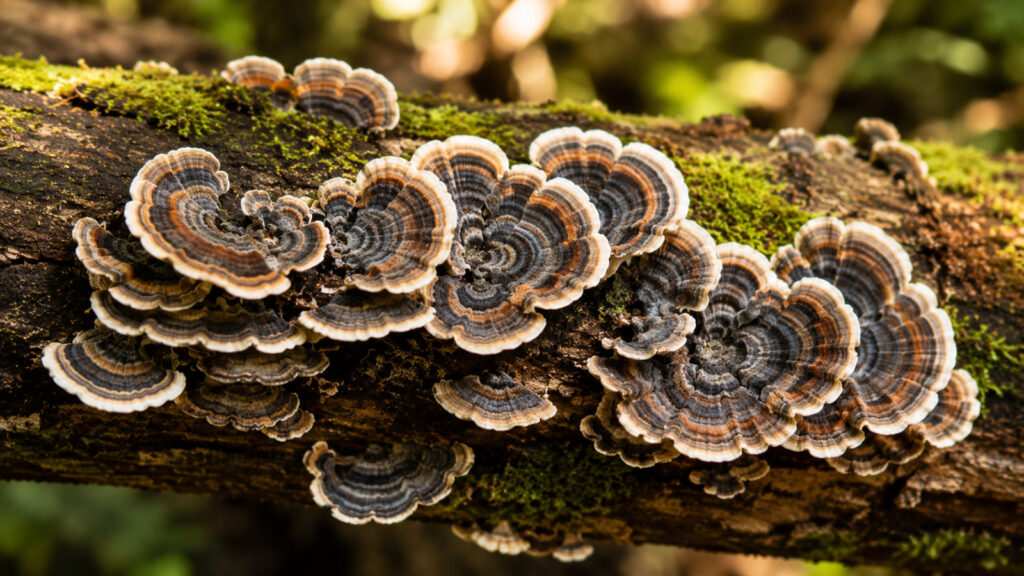
Walk any damp forest and you have seen it: fan-shaped shelves in concentric bands (tan, brown, blue-grey) stacked on dead logs like ruffled feathers, which is the entire etymology. Trametes versicolor (formerly Coriolus versicolor) is among the most common fungi on earth and among the longest-used in traditional East Asian medicine, where it is yun zhi.
Modern interest centers on two protein-bound polysaccharides (PSP and PSK) extracted from it, plus the beta-glucans it shares with other functional mushrooms. PSK has decades of use in Japanese medicine alongside conventional treatment. That human research is the backdrop; the reason turkey tail leads every conversation about mushrooms for dogs is one specific study.
The Penn study: the real numbers, and the real limits
In 2012, Dr. Dorothy Cimino Brown’s team at the University of Pennsylvania School of Veterinary Medicine published a trial of a standardized PSP extract (the commercial preparation I’m-Yunity) in dogs with splenic hemangiosarcoma, an aggressive cancer with a grim baseline: published historical survival for surgery alone ranges widely, with medians reported from roughly 19 to 86 days. Fifteen dogs received the extract at one of three daily doses after splenectomy, with no other treatment and no concurrent control group.
The finding that made headlines: the highest-dose group’s median survival was 199 days, longer than that historical range, though the differences between the three dose groups were not statistically significant, and the extract was well tolerated throughout.
Now the part the supplement bottles skip. Fifteen dogs is a small trial. There was no concurrent placebo group; the comparison was to historical outcomes, a real but weaker form of evidence.
It studied one standardized extract at specific doses, not the category of turkey tail powders generally. And it studied survival time with one cancer, not prevention, not cure; several dogs still progressed. The researchers said it best themselves: promising enough to warrant a bigger trial.
That bigger trial has since happened, and this is the part the hopeful forum threads almost always skip. A larger follow-up published in 2022 included 101 dogs after splenectomy. Fifty-one received the same standardized extract alone; 25 received doxorubicin with placebo; and 25 received doxorubicin with the extract. Adding the extract to doxorubicin did not improve survival.
In a sex-specific analysis, females given the extract alone had shorter survival than females given doxorubicin with placebo, but owners chose extract alone versus chemotherapy, so that comparison was not randomized and cannot show that the extract caused the difference. Both studies reported funding from companies associated with I’m-Yunity.
So the real shape is this: one small, genuinely encouraging early study, and a larger one that could not confirm it. That is not a reason to dismiss turkey tail (its everyday use rests on separate immune-support reasoning, not on these cancer studies), but it is a reason to be truthful about what a supplement is and is not, and to keep a dog with cancer under an oncologist’s care rather than a bottle’s.
| Study | Dogs | Design | Main finding | Main limitation |
|---|---|---|---|---|
| Brown and Reetz, 2012 | 15 | Three extract dose groups after splenectomy; no placebo or concurrent untreated group | An encouraging signal on time to progression; survival differences between the dose groups were not statistically significant | Five dogs per group; compared against historical outcomes; company funding |
| Gedney and colleagues, 2022 | 101 | Extract alone, or chemotherapy with the dogs on that pathway randomized to extract or placebo | Adding the extract to doxorubicin did not improve survival | Extract-alone versus chemotherapy was owner-chosen, not randomized; company funding |
What this means for a dog who is not in that study
For the ordinary senior dog, turkey tail’s case is the immune-support case: its polysaccharides interact with immune cell receptors (the biology PSP and PSK research has mapped for decades) and supporting normal immune function is a reasonable goal for an aging body. Those same beta-glucans double as prebiotic fiber, feeding the gut bacteria that do much of the immune system’s work, which is why gut and immune support tend to travel together.
That is the everyday case for turkey tail as a supplement: it is used for daily immune and gut support, most often in senior dogs, as a fruiting-body extract with stated beta-glucan content and a certificate of analysis (the checklist below) though controlled evidence for those benefits in healthy dogs is limited. What it is not, from us or anyone, is a treatment for disease. A dog with a diagnosis needs its veterinary team, and a supplement only ever belongs in that picture through the vet who owns the plan.
Does turkey tail help with fatty lumps on dogs?
Not based on any published canine study. The two clinical trials studied a standardized PSP extract in dogs with splenic hemangiosarcoma, not benign lipomas, and neither trial tested whether a lump became smaller.
A soft lump may be a lipoma, but appearance and feel alone cannot confirm it. Have any new or changing lump examined by your veterinarian. A fine-needle aspirate is a common first test.
Turkey tail may be used to support normal immune function. It is not a lump treatment.
Choosing a turkey tail supplement: the four checks
- Material clearly stated: the label should say whether the product contains fruiting body, pure cultured mycelium, mycelium grown on grain, or a standardized extract. Be cautious when the material, residual grain, extraction method, or beta-glucan content is not disclosed.
- Beta-glucans, numbered: a standardized percentage on the label. “Polysaccharides” without a beta-glucan number can be starch wearing a lab coat.
- A COA you can see: identity, potency, heavy metals, contaminants: mushrooms concentrate what they grow in, which makes third-party testing non-optional.
- Species and amount, plainly: Trametes/Coriolus versicolor by name, milligrams per serving, no proprietary-blend fog.
How much turkey tail do you give a dog?
There is no single official dose, and honest sources say so. In the Penn trial, dogs received a standardized PSP extract at 25 to 100 mg per kilogram of body weight daily, a research amount, given under veterinary supervision, for a specific cancer, not a wellness figure to copy at home. For everyday immune support the practical answer is simpler: follow the exact dog-specific label, dosed for your dog’s weight, and confirm with your veterinarian: the stated beta-glucan content helps you compare products, not calculate a dose.
One point trips up almost everyone, so it is worth stating plainly. Those research figures are milligrams per kilogram of a specific standardized extract, not a universal beta-glucan dose, and different extracts are not interchangeable. A stated beta-glucan percentage helps you compare one product’s composition against another, and when a label also discloses the amount of that extract per serving, you can estimate the beta-glucan in a serving, but neither tells you the dose your dog should receive, because no standard wellness dose for turkey tail in dogs has been established.
And one rule holds across every source and every product: never feed raw or wild turkey tail. The shelf is woody and hard to digest, foraging risks a toxic look-alike, and extraction is used because it can concentrate the useful compounds and improve access to them.
What not to mix with turkey tail
There is no useful universal list. The 2022 canine trial studied one standardized extract with doxorubicin, but reliable interaction data for most other drugs are lacking. This is still one of the most common questions from owners whose dogs are already on a full medication list, and it deserves a real answer rather than a shrug. Turkey tail is immune-active, and reliable studies of it combined with common canine drugs are lacking, so the honest position is that your veterinarian, not a website, owns the decision to combine it with anything else. Here is why each situation earns that caution, so the conversation with your vet is a short one:
- Dogs in cancer treatment. Supplement interactions can depend on the specific treatment protocol, and many combinations have not been adequately studied. The oncologist should review every supplement before it is added.
- Dogs on immune-modulating or immune-suppressing drugs (for example prednisone, cyclosporine, or oclacitinib, sold as Apoquel). These medications alter immune signaling in different ways. Because turkey tail may also affect immune activity and reliable combination studies in dogs are lacking, your vet should review the specific drug, dose, diagnosis, and supplement before they are used together.
- Dogs on anticoagulants, or facing surgery. Reliable canine data have not established whether turkey tail affects anticoagulant drugs or surgical bleeding risk. Because the consequences of an interaction could be serious, disclose it before surgery or use alongside a blood thinner rather than assuming the combination is harmless.
- Dogs with diabetes or another closely monitored condition should have any new supplement added through the veterinarian managing that condition, so the rest of the plan stays steady.
Two habits turn this from stressful into simple. Bring the complete list, prescriptions, over-the-counter products, and supplements alike, to your veterinarian before you add anything. And when it is medically appropriate and your vet agrees, introduce only one optional supplement change at a time while your dog is otherwise stable, because starting a supplement alongside a new medication makes it harder to tell which change caused a benefit or a problem.
Talk to your veterinarian first if
Your dog is in cancer treatment (your veterinarian should review it alongside your dog’s medications and treatment plan), takes immunosuppressive or anticoagulant medications, has diabetes, or has an autoimmune condition. And a dog with new symptoms, lumps included, needs a diagnosis first, not a supplement: turkey tail has never made a needed vet visit optional.
References and further reading
- Brown DC, Reetz J (2012). Single agent polysaccharopeptide delays metastases and improves survival in naturally occurring hemangiosarcoma (Evidence-Based Complementary and Alternative Medicine / PMC).
- Penn Today. Compound derived from a mushroom lengthens survival time in dogs with cancer.
- Gedney A, et al. (2022). Evaluation of the anti-tumour activity of Coriolus versicolor polysaccharopeptide (I’m-Yunity) alone or in combination with doxorubicin for canine splenic hemangiosarcoma (Veterinary and Comparative Oncology). The larger follow-up (101 dogs) that did not confirm a survival benefit.
- PetMD. Medicinal mushrooms for dogs. (Vet-reviewed general overview of functional mushrooms in dogs.)
- Cornell University College of Veterinary Medicine. Lipomas in dogs: veterinary evaluation and fine-needle aspiration.
Frequently asked questions
Does turkey tail really help dogs with cancer?
In a 2012 pilot, the five dogs on the highest dose had a median survival of 199 days, longer than historical estimates, but the study had no concurrent control group, and a larger 2022 study did not confirm a survival benefit. So the whole picture is an encouraging early signal that a bigger trial could not reproduce, not a proven treatment. A dog with cancer needs an oncology team. Turkey tail enters that conversation through the oncologist, never instead of one.
Is turkey tail mushroom actually good for dogs?
It may support normal immune function, but dog-specific clinical evidence is limited. The published canine studies tested one standardized PSP extract in dogs with splenic hemangiosarcoma. A small 2012 pilot was encouraging, while a larger 2022 study did not confirm a survival benefit. Those studies do not establish that ordinary turkey tail products improve health in otherwise healthy dogs, and anyone claiming otherwise is selling past the evidence.
How fast does turkey tail mushroom work in dogs?
No onset time has been established in dogs, and normal immune support is not something most owners can measure from day to day. Do not treat a promised number of days as proof that a product is working. Follow the label and reassess continued use with your veterinarian. If you started for a specific reason, a simple dated note each week gives you and your vet far more than memory does.
Can turkey tail be given with other medications?
There is no one-size-fits-all answer. Reliable canine interaction studies are lacking for most drugs, so your veterinarian should review turkey tail alongside any cancer treatment, immunosuppressant, anticoagulant, or other closely monitored medication.
How much turkey tail should I give my dog?
Follow the exact dog-specific label, dosed for your dog’s weight, and confirm with your veterinarian: the beta-glucan percentage helps you compare products, not calculate a dose, and there is no single official figure for wellness use. For context, the Penn cancer study used a standardized PSP extract at 25 to 100 mg per kilogram daily under veterinary care, which is a research dose for a diagnosis, not a guideline for a healthy dog.
Does turkey tail shrink lipomas in dogs?
No published canine study has shown it. See the section above for what the studies did and did not test, and have any new or changing lump examined by your veterinarian.
What are the side effects of turkey tail for dogs?
Canine safety data are limited and product-specific, but the most commonly reported issue is mild digestive upset, usually settled by giving it with food or easing back the amount. Talk to your vet first if your dog has a bleeding disorder, diabetes, or an autoimmune condition, or is in cancer treatment, and never use raw or wild mushrooms.
Can I give my dog human turkey tail supplements?
Sometimes. A human product is not automatically worse, and a pet label is not automatically better. A standardized extract, a fruiting-body product, and mycelium grown on grain are not interchangeable. The label should name Trametes versicolor, identify the material used, state milligrams per serving, and provide a lot-specific certificate of analysis. Avoid xylitol and other dog-unsafe additives. A dog-specific product can make serving sizes easier, but your veterinarian should still confirm that the product is appropriate for your dog.
How will I know if turkey tail is working?
Immune support is not a switch you will watch flip; there is no dramatic day-one change, which is why owners split between “it worked instantly” and “it is all placebo.” Neither is a fair read. There is no established onset time or reliable at-home marker for immune support in dogs, so give it a fair, label-length trial rather than watching for a quick change. If you started for a specific reason, jot a simple dated note each week and reassess continued use with your vet: a month of notes tells you far more than memory, and it is exactly the record your vet can use.
What if my dog gets too much turkey tail?
Do not try to calculate a home antidote. If the amount was large or unknown, or your dog develops vomiting, diarrhea, weakness, unusual behavior, or another symptom, call your veterinarian or an animal poison service and have the product label ready.
Educational content, not a substitute for veterinary advice. These statements have not been evaluated by the FDA. This product is not intended to diagnose, treat, cure, or prevent any disease.
This guide is educational and is not a substitute for veterinary diagnosis or care. If you are worried about your dog, talk to your veterinarian.