

Cordyceps, Chaga, Maitake, Shiitake: The Rest of the Blend Label, Honestly

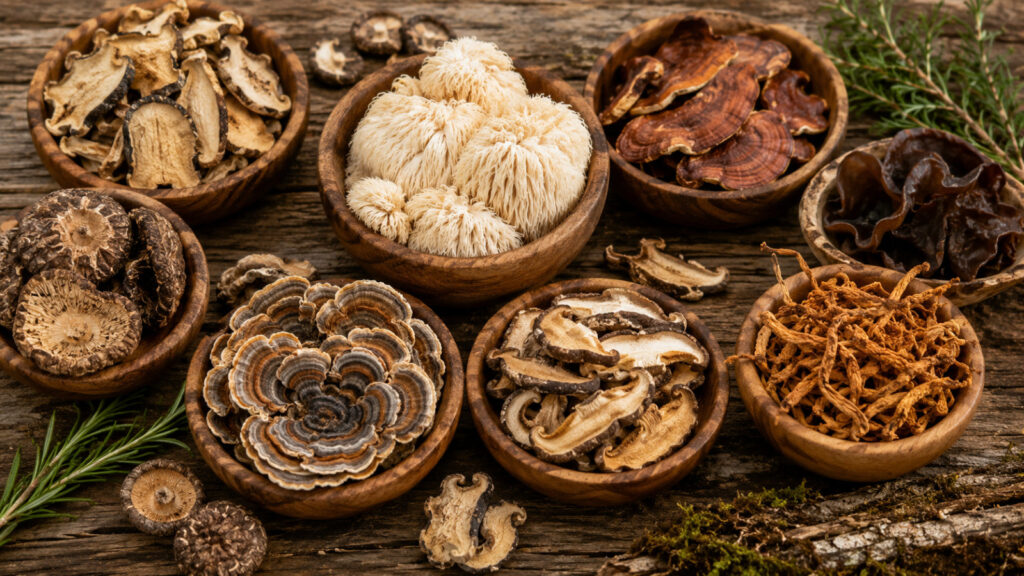
Pick up any ten-mushroom blend and past the big three (turkey tail, lion’s mane, reishi) the label rolls on: cordyceps, chaga, maitake, shiitake, tremella. Owners reasonably wonder whether those names are medicine or set dressing. The real answer sits in between and varies by mushroom: real traditions and genuinely interesting human-and-laboratory research, attached to dog-specific evidence that ranges from thin to nonexistent. Here is each one, told straight.
Quick answer
The supporting-cast mushrooms are commonly included at supplement servings and each carries a plausible story – cordyceps for energy and endurance, chaga for antioxidants, maitake for immune support, shiitake for immune and general wellness.
What none of them carries is positive dog-specific efficacy evidence – maitake was tested in a canine lymphoma trial but showed no measurable response. Otherwise their research is human, laboratory, or traditional.
Practical translation: they are reasonable passengers in a blend but weak reasons to buy one – choose products led by the studied species (turkey tail, reishi, lion’s mane) at stated amounts, and treat the rest of the label as bonus, not backbone.
The roundup, one honest paragraph each
Cordyceps – famous from Tibetan tradition and human athletic-performance research (energy, endurance, oxygen use), with laboratory work on inflammation. Dog evidence: essentially none published. The energy story makes it a common senior-blend passenger; the fair read is plausible-and-unproven.
Chaga – the birch fungus with a strong antioxidant profile and Nordic-Russian folk history. Its research is largely laboratory. Dog trials do not exist, and one caution follows it: chaga is notably high in oxalates, and human case reports link heavy use to oxalate kidney injury. With no canine data either way, dogs with kidney disease or bladder-stone history should avoid chaga-heavy products – one more reason blend labels need reading.
Maitake – “hen of the woods,” a culinary mushroom whose beta-glucan fraction has real human immune research. It is also the one supporting-cast mushroom with a published canine trial: a 2007 study in 15 dogs with lymphoma found the maitake fraction produced no measurable tumor response, though it was well tolerated. Directionally interesting, but not shown to work in dogs.
Shiitake – dinner-table famous as food, with human research on its lentinan polysaccharide. In dog terms mostly a nutritional bonus; its safety as a concentrated supplement in dogs is not well characterized.
Tremella and the rest of the long tail – skin-and-hydration marketing built on human cosmetic research; in a dog blend, set dressing.
What the thin evidence actually means (and does not)
Thin evidence is not evidence of harm – these species are widely consumed, several for centuries, though their safety as concentrated supplements in dogs is not well characterized. It is evidence of priority: research money went to the big three first because their stories were strongest, and the supporting cast simply has not had its canine turn.
Two practical consequences. First, never buy a blend FOR its exotic passengers: marketing emphasis does not tell you how much of each ingredient is present. Judge the product by disclosed per-species amounts, not the prominence of names on the front label. Second, the passengers dilute by design: every milligram of shiitake in a fixed-size chew is a milligram not spent on turkey tail – the arithmetic our choosing guide calls the ten-mushroom trap.
The plain takeaway: judge a product by the studied species at stated amounts rather than the number of names on the label – your dog’s serving is finite, and the evidence says where to spend it.
If a blend you like includes them
Fine – run the standard audit: the big three present at stated, meaningful amounts (the backbone test), fruiting-body sourcing and beta-glucan numbers (the quality page), COA visible, and the passengers riding along at labeled amounts rather than headlining. Mind the chaga-oxalate note for stone-prone dogs, apply the standing vet-first cautions from the main guide (immunosuppressives, anticoagulants, autoimmune disease), and judge the product by its backbone. A good blend with passengers is a good product; passengers without a backbone are potpourri.
Talk to your veterinarian first if
Your dog has kidney or bladder-stone history (skip chaga-heavy products), takes immune-active or blood-thinning medications, has autoimmune disease, or is in treatment for anything serious – the same short list as every mushroom page, because it is the list that matters. And supplements never postpone the diagnosis a symptomatic dog needs.
References and further reading
- PetMD. Medicinal mushrooms for dogs.
- Merck Veterinary Manual. Pharmacology.
- Griessmayr PC, et al. (2007). Mushroom-derived maitake PETfraction as single agent for the treatment of lymphoma in dogs – found no measurable response (J Vet Intern Med).
- Chaga mushroom-induced oxalate nephropathy – human case report underlying the chaga kidney caution (PubMed).
Frequently asked questions
Is cordyceps good for dogs?
Dog-specific safety data are essentially absent, and it carries an interesting human energy-and-endurance research story – but no published dog trials. Reasonable as a blend passenger for a senior; weak as the reason to choose a product.
Is chaga safe for dogs?
Dog-specific safety data are limited, and chaga carries one specific caution: it runs high in oxalates, and human case reports tie heavy use to oxalate kidney injury – so dogs with kidney disease or bladder-stone history should avoid chaga-heavy products. As always, the vet-first list applies to immune-active supplements.
Which mushroom is best for dog immune support?
Turkey tail by evidence (the canine trial lives there), reishi close behind (the 2024 beagle study). Maitake tells a directionally similar beta-glucan story; its one canine trial (lymphoma, 2007) found no measurable response. Buy the backbone, welcome the passengers.
Why do blends include ten mushrooms if only three are studied?
Because labels sell breadth and ingredient lists photograph well. The arithmetic works against the buyer: fixed serving size divided ten ways means sprinkles of everything – which is why the audit is always the backbone amounts, not the name count.
Educational content, not a substitute for veterinary advice. These statements have not been evaluated by the FDA. This product is not intended to diagnose, treat, cure, or prevent any disease.
This guide is educational and is not a substitute for veterinary diagnosis or care. If you are worried about your dog, talk to your veterinarian.