

How to Choose a Mushroom Supplement for Dogs: The Label-Reading Masterclass

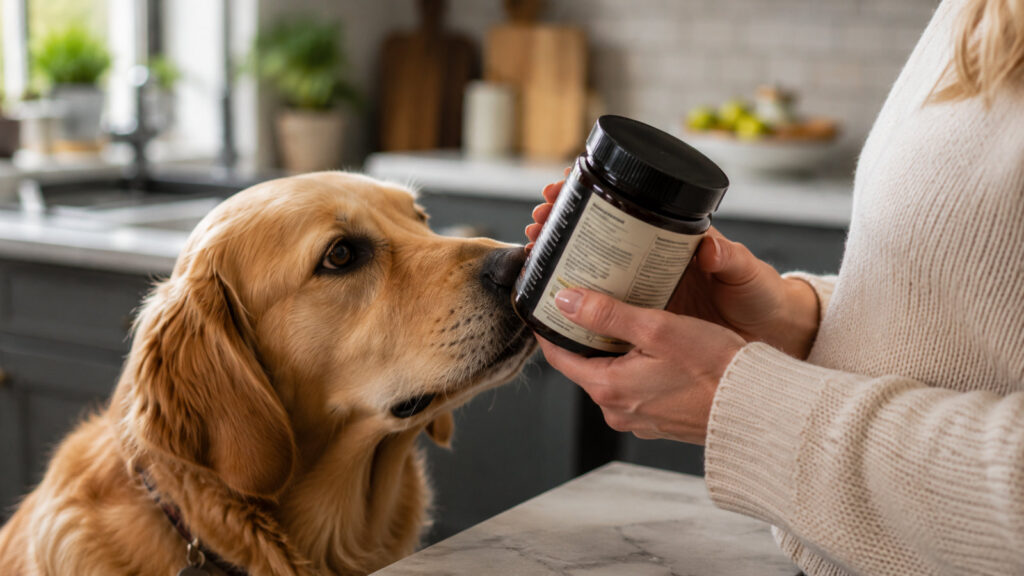
Type “best mushroom supplement for dogs” and you get lists ranked by affiliate commission. This page does the useful version instead: it teaches the five label checks that separate real mushroom products from expensive grain flour – because in this category, quality is not a matter of taste, it is a matter of chemistry that shows up (or hides) right on the label. Learn the checks and every “best of” list becomes unnecessary.
Quick answer
Judge any mushroom supplement with five checks:
- The material stated plainly – fruiting body, pure cultured mycelium, mycelium grown on grain, or a standardized extract. Grain-grown products can run a third or more starch by industry testing, so undisclosed material is the red flag.
- A standardized beta-glucan percentage – the number starch products cannot print; “polysaccharides” is not the same claim.
- A certificate of analysis you can actually view.
- Species by Latin name with milligrams per serving (no proprietary-blend fog).
- Dog-specific formulation (no xylitol, no human-blend additives).
Blend versus single: pick by job – a targeted single species for a specific goal is easier to judge than a shallow blend of ten.
The five checks, in the order they eliminate products
- Check 1 – the material-disclosure test. The front of the package says mushroom; the ingredient line tells the truth. “Fruiting body extract” = the mushroom itself, where beta-glucans and signature compounds concentrate. “Mycelial biomass,” “full spectrum mycelium,” or rice and oats in the ingredients = grain-grown product, where industry testing (NAMMEX) has found starch running to a third or more. The fault is poor disclosure and residual grain, not mycelium as a category: the one turkey tail preparation with canine trials behind it is a standardized extract grown from cultivated mycelia, which is why “what is it, exactly” beats “fruiting body or bust.” (The nuance, when mycelium legitimately matters, lives in its own deep-dive.)
- Check 2 – the beta-glucan number. Quality products state it: “standardized to 30 percent beta-glucans.” Products that say only “rich in polysaccharides” are exploiting a chemistry loophole – starch is a polysaccharide too, so a grain-heavy product can print that phrase honestly while containing little of what you came for. A missing beta-glucan number is a transparency red flag – it does not prove low potency, but it makes a fair comparison impossible.
- Check 3 – the COA you can see. Mushrooms concentrate what they grow in (heavy metals included) which makes third-party testing for identity, potency, and contaminants non-optional. A certificate of analysis available on request (or better, published) is the difference between claims and evidence. This is the same habit our CBD guides teach, for the same reason.
- Check 4 – species and amounts, plainly. Latin names (Trametes versicolor, not just “immune blend”) and milligrams per serving, per species. A “proprietary mushroom complex, 500 mg” refuses to tell you whether each species is present at a meaningful amount – reason enough to pass, whatever it contains.
- Check 5 – built for dogs. Human products carry sweeteners, flavorings, and occasionally xylitol (toxic to dogs); dosing logic differs too. A dog-formulated product with the first four checks passed is the whole target.
What a useful certificate of analysis should show
A label and a certificate of analysis answer different questions. The label should name each species, identify whether the material is fruiting body, pure cultured mycelium, mycelium grown on grain, or a standardized extract, and state milligrams per serving.
The certificate should match the product lot and report identity, beta-glucans using a method that distinguishes them from alpha-glucans or starch, and contaminant results for heavy metals and microbes. Pesticide and mycotoxin testing may also be appropriate, depending on the material and how it was produced.
A NASC Quality Seal reflects audited quality procedures, adverse-event reporting, labeling requirements, and random testing. It is not proof that the product works.
Blend or single species? Pick by job, not by count
Blends look like better value (ten mushrooms!) and often are the opposite: a fixed serving divided ten ways can leave very little of each, and an undisclosed blend gives you no way to know which species dominate. The logic: a specific goal deserves a targeted product (immune support for a senior points at turkey tail, the aging-brain conversation at lion’s mane, immune balance at reishi) at a meaningful amount of that species.
Blends earn their place when a formulator chose two or three complementary species at stated, meaningful amounts each (the label shows this – check 4 again), not when marketing chose ten at a sprinkle. Either format can work. A single-species product is easy to evaluate, and a disclosed two-to-three species formula can be reasonable too – the checks above are what matter, not the count.
Serving literacy (the part that is not dosing advice)
We never publish dosing (amounts belong to labels and vets), but reading a serving panel is a literacy skill worth having: compare products per-serving, not per-jar (a cheaper jar with half the mushroom per serving is the expensive one); check what a serving is for YOUR dog’s size (some labels quietly assume a 30-pound dog; a Great Dane household is buying weeks, not months); read extract ratios in context (an 8:1 ratio describes how much raw material went in, not verified potency, which is why milligram counts alone cannot compare an extract to a powder; the beta-glucan percentage is the real cross-product comparator); and run the trial like a scientist anyway – our fair-test method applies to this aisle unchanged: one product, its labeled lead time, three scored behaviors, honest verdict.
Before any mushroom supplement
Run the standing cautions: vet-first for dogs on immunosuppressives or anticoagulants, with autoimmune disease, or in cancer treatment (the oncologist owns that supplement list). Add it to your clinic’s medication inventory, start when your dog is otherwise stable (new supplement plus new symptoms = uninterpretable), and let your vet know what the label says – a photo of the panel answers most questions in one text.
References and further reading
- PetMD. Medicinal mushrooms for dogs.
- Brown DC, Reetz J. Polysaccharopeptide in canine hemangiosarcoma (the Penn study).
- NAMMEX. Redefining medicinal mushrooms – industry beta-glucan and starch testing behind the label checks (a mushroom-ingredient supplier’s own data).
Frequently asked questions
What is the best mushroom supplement brand for dogs?
The straight answer is a checklist, not a brand: the material identified plainly (fruiting body, pure cultured mycelium, mycelium grown on grain, or a standardized extract), a stated beta-glucan percentage, a visible COA, Latin-named species with per-serving milligrams, and dog-specific formulation. Any product passing all five is a legitimate choice. A product that will not disclose fruiting-body source or beta-glucan content has a real transparency gap, whatever the reviews say.
Are mushroom blends better than single mushroom supplements?
Neither is automatically better: a single-species product is easier to evaluate, while a blend can be reasonable when every species and amount is disclosed. Choose a targeted species for a specific goal at a meaningful stated amount – or a deliberate two-to-three species formula with per-species numbers on the label. A ten-mushroom proprietary blend gives you no way to know whether any species is present at a meaningful amount.
How do I know if a mushroom supplement is actually working?
Score it like any supplement: three observable behaviors rated before starting, the label’s full stated lead time respected (there is no validated onset in dogs, so use the label’s window rather than judging in days), then an honest re-score. Immune support is the hardest goal to observe at home, which makes the quality checks before purchase matter even more.
Can I give my dog two mushroom supplements at once?
Complementary species are commonly combined – but start one at a time (so effects and any stomach grumbles have a clear author), keep total additions sensible, and run the combination past your vet if any caution flag applies. More is not the goal; matched-to-job is.
What is the best turkey tail mushroom for dogs?
There is no evidence-based best brand. Start with a product that names Trametes versicolor, states the material used and milligrams per serving, reports beta-glucans rather than only total polysaccharides, and provides a lot-matched certificate of analysis. A pet label can make serving sizes easier, but it does not replace those checks. Our full evidence review of turkey tail mushroom for dogs covers what the canine studies did and did not show.
Where can you buy turkey tail for dogs?
Turkey tail products are sold through veterinary clinics, pet retailers, marketplaces, and brand websites. The store is not the quality test. Check the current label and lot-specific certificate of analysis before buying, because formulas and marketplace listings can change.
Educational content, not a substitute for veterinary advice. These statements have not been evaluated by the FDA. This product is not intended to diagnose, treat, cure, or prevent any disease.
This guide is educational and is not a substitute for veterinary diagnosis or care. If you are worried about your dog, talk to your veterinarian.