

Pet CBD Buyer’s Guide: 7 Things to Check
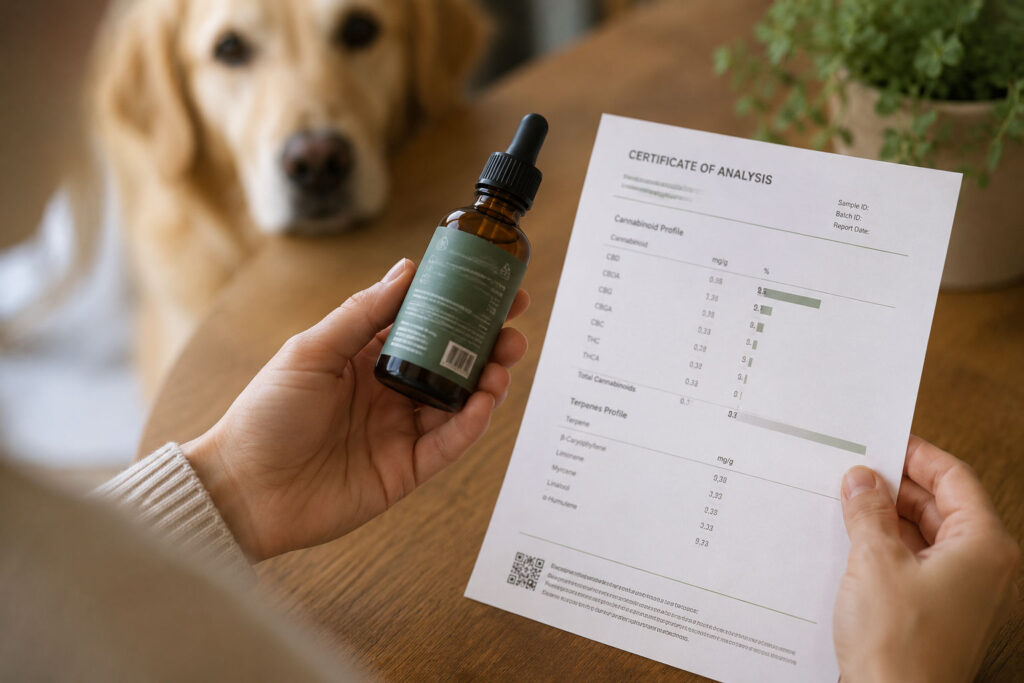
Buying CBD for your pet is the part that goes wrong most often, because the market is poorly regulated and the label cannot always be trusted. Independent testing has repeatedly found pet CBD products that do not match their labels – in one analysis of 29 products, only about a third were within ten percent of the CBD they claimed, a few had no detectable cannabinoids, and some contained contaminants or more THC than allowed. The good news: a handful of checks rule out almost every bad product. Here are the seven that matter.
1. A current certificate of analysis (COA)
This is the single most important check. A COA is an independent lab report showing what is actually in the bottle – how much CBD, and how much THC. A trustworthy brand makes it easy to find and keeps it current for your batch. No COA, no purchase. Everything else on this list is secondary to this one.
2. THC content – broad spectrum for pets
THC can be toxic to dogs and cats, so for pets you want a broad-spectrum (THC-free) product, confirmed by the COA at or below the legal limit. Broad spectrum keeps the beneficial cannabinoids and the entourage effect while removing the THC. We explain the spectrum choices in hemp vs CBD.
3. A clear milligram strength
The label should state the total CBD in milligrams and the strength per milliliter (or per chew). Without it you cannot dose accurately, and “strength” claims you cannot verify are a red flag. You need this number to use a dosage calculator.
4. Price per milligram, not price per bottle
A cheap-looking bottle can be the most expensive CBD you will ever buy if it is weak. Compare products on price per milligram of CBD: divide the price by the total milligrams. A “$30 bottle” with 150 mg is far pricier per dose than a “$50 bottle” with 750 mg. This one number cuts through most marketing.
5. Made for pets – and for the right species
Use a product formulated for pets, not a repurposed human product (which can be too strong or contain flavorings and essential oils that are unsafe, especially for cats). And match the species: cats are more sensitive than dogs and should have a cat-specific product. See CBD for cats and CBD for dogs.
6. A clean carrier and ingredient list
Check what the CBD is mixed into. A simple, high-quality carrier oil is ideal. Many of the mild side effects people blame on CBD actually come from the carrier oil or added ingredients, so fewer, cleaner ingredients are better – particularly for cats.
7. A real company that does not make medical claims
There are no FDA-approved CBD products for pets. Any brand promising to “cure,” “treat,” or “heal” a disease is breaking the rules and showing you it cannot be trusted. Look instead for a real company with veterinary input, contact information, quality certifications such as NASC, and honest, structure-function language. Trustworthy brands tell you what CBD can and cannot do.
Do the dosing math before you buy
Once a product passes the checks, make sure it can actually deliver your pet’s dose at a reasonable cost. Plug the strength into our CBD dosage calculator to see the dose in milliliters and how long a bottle will last. A product that needs half a bottle per dose is the wrong strength for your pet.
Frequently asked questions
How do I know if a CBD product is good quality?
Start with the certificate of analysis (COA): it should confirm the CBD amount and THC at or below the legal limit. Then check for a clear milligram strength, a pet-specific formula, a clean carrier, and a reputable company that makes no disease claims.
What is a COA for CBD?
A certificate of analysis is an independent lab report showing exactly what is in the product – cannabinoid content and contaminant testing. It is the best protection against mislabeled products.
Why is CBD price per mg important?
Because bottle price hides strength. Comparing price per milligram of CBD shows the true cost per dose and stops you overpaying for a weak product.
Is human CBD oil OK for pets?
Better to use a pet product. Human CBD can be too concentrated or contain flavorings and essential oils that are unsafe, especially for cats.
These statements have not been evaluated by the Food and Drug Administration. This product is not intended to diagnose, treat, cure, or prevent any disease. Educational content, not a substitute for veterinary advice.
This guide is educational and is not a substitute for veterinary diagnosis or care. If you are worried about your pet, talk to your veterinarian.