

Enlarged Heart in Dogs: What the Finding Means and What Happens Next


“Your dog’s heart looks enlarged.” If a veterinarian has said that after an x-ray or an ultrasound, the first thing to hold onto is that an enlarged heart is a finding, not a final diagnosis. It is a sign that something about the heart, or the sac around it, needs a closer look, and several different conditions can be the something. What happens next, and what it means for your dog’s years ahead, depends on which one it is, how far along it is, and whether symptoms have started.
This guide walks through the causes, the questions your vet is about to answer, treatment realities, and the honest version of the life-expectancy question.
Quick answer
An enlarged heart on an x-ray or ultrasound means the heart’s outline, or its individual chambers, measure bigger than expected. The common causes in dogs are leaky-valve disease (the most frequent acquired heart disease, especially in small older dogs), dilated cardiomyopathy or DCM (a weakening of the heart muscle, mostly in large breeds), fluid around the heart, heartworm disease, and some birth defects. The finding itself does not say which one, and it does not say how long your dog has.
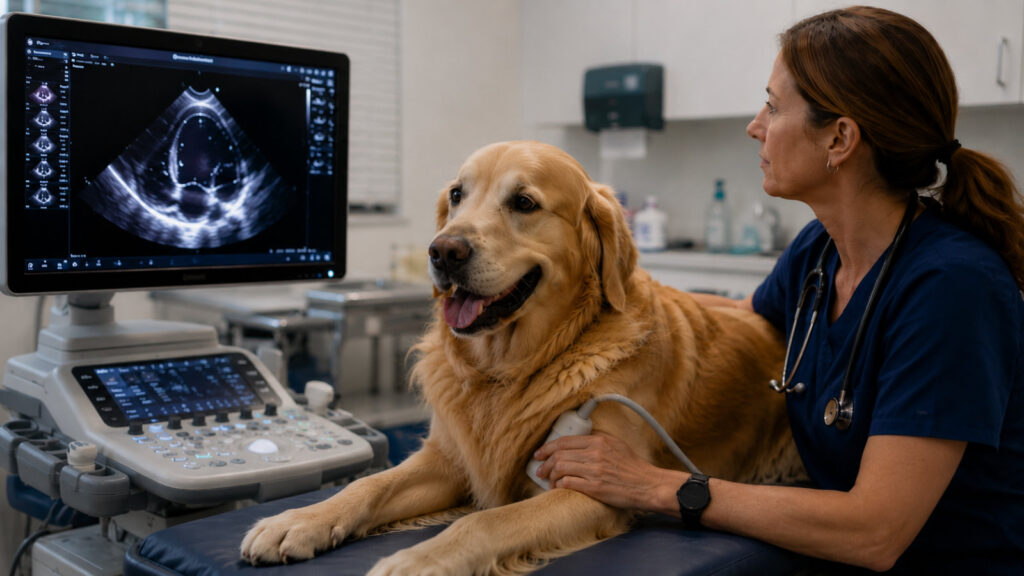
For a stable dog, the test that usually settles it is an echocardiogram, an ultrasound of the heart, often performed or read by a veterinary cardiologist. Some dogs, especially with early-stage disease, stay comfortable for years on the right treatment, while others face a shorter course; life expectancy depends on the cause, the stage, and whether symptoms have started, not on the word “enlarged” itself.
What “enlarged heart” actually means
Veterinarians usually spot cardiac enlargement one of two ways. On a chest x-ray, the heart’s shadow, what vets call the silhouette, looks bigger than it should for your dog’s size and breed, often measured against the vertebrae as a score. On an ultrasound, individual chambers measure larger than normal. The distinction matters because hearts enlarge in different patterns: stretched, thin-walled chambers point one direction; a heart squeezed by fluid in the sac around it points another; one enlarged chamber with the rest normal points somewhere else again.
Chambers truly enlarge when the heart is handling extra volume or pressure, or when the muscle itself weakens: a valve that leaks makes chambers handle the same blood twice, and a weakened muscle stretches as it fails to empty properly. Fluid in the sac around the heart can also make the silhouette look bigger on an x-ray even when the chambers are not enlarged. The pattern of the enlargement is a clue, which is why the finding starts an investigation rather than ending one.
What causes an enlarged heart in dogs
| Cause | Who it usually affects | The short version |
|---|---|---|
| Mitral valve disease | Small and medium breeds, middle-aged and older | A heart valve wears and leaks; the most common acquired heart disease in dogs. Usually first noticed as a heart murmur, often years before it causes trouble |
| Dilated cardiomyopathy (DCM) | Mostly large and giant breeds; some suspected diet-associated cases | The heart muscle itself weakens and stretches. The full story, breeds, the grain-free question, treatment, lives in our DCM guide |
| Pericardial effusion | Any dog; some breeds more often | Fluid builds in the sac around the heart and squeezes it; the silhouette looks big even though the heart muscle may be normal |
| Heartworm disease | Dogs without consistent prevention | Adult worms mainly damage the lung arteries, which can strain and enlarge the right side of the heart; see our heartworm guide |
| Congenital defects | Young dogs | A defect present from birth loads part of the heart; often first suspected from a murmur in a puppy |
One reassurance worth naming: chest shape and normal breed differences can change how large a heart looks on an x-ray, so an unusual-looking silhouette is not always disease. That is one more reason the finding leads to an echocardiogram rather than straight to a diagnosis.
The questions that decide everything
When your vet or a cardiologist works up an enlarged heart, they are answering three questions. Which condition is it, usually settled by the echocardiogram, sometimes with x-rays, an ECG for rhythm, blood pressure, and a heartworm test alongside. How far along is it, staged by the measurements that matter for that diagnosis and by whether the body is still compensating, meaning holding circulation steady with no signs of failure yet. And is it causing symptoms yet, because the line between “enlarged but comfortable” and “in heart failure” changes both treatment and prognosis substantially, though some conditions are treated before symptoms begin.
That last question is why two dogs with the same x-ray can have very different years ahead. A dog whose heart is enlarged but who breathes normally, sleeps well, and exercises happily is in a very different place from a dog who coughs at night or tires in a block.
What can be done
Treatment follows the cause, and for many dogs it improves comfort and extends good-quality time, though how much varies with the diagnosis and stage. Leaky valves and weakened muscle, when they need treatment, are managed with heart medications your vet will tailor and adjust, drugs that support the heart’s pumping, control fluid, and ease its workload; early-stage disease sometimes needs only monitoring.
Fluid around the heart is often relieved by draining it, which can rapidly take the pressure off the heart. Heartworm has a specific treatment protocol. Congenital defects sometimes have corrective procedures. None of this cures an aging valve or a weakened muscle; what it can do, for many dogs, is extend the comfortable stretch, which is the outcome that matters.
At home, for a dog at risk of congestive heart failure, the highest-value habit is tracking the sleeping breathing rate; it is one of the most useful early warnings that heart failure may be developing, and the monitoring section of our congestive heart failure guide shows exactly how to count it. Beyond that: keep weight lean, keep prevention current, and keep the recheck schedule your vet sets, because staging is only as good as its latest measurement.
Life expectancy, honestly
The question every owner asks deserves a straight answer, and the straight answer is that “enlarged heart” alone cannot give one. The range is genuinely wide: a small dog with early valve disease and no symptoms may stay comfortable for years with monitoring and well-timed medication. A large dog whose DCM has progressed to congestive heart failure usually has time measured in months, though treatment meaningfully extends the comfortable portion. Fluid around the heart depends heavily on why the fluid came.
The variables that actually move the number are the cause, the stage at diagnosis, whether symptoms have started, and how the dog responds to treatment in the first weeks. Your cardiologist’s estimate after the echocardiogram, for your dog, at this stage, will beat anything a page can tell you. What a page can tell you: the finding is a reason to act, not a verdict.
The final stages, and knowing them early
Owners also ask what the end of untreated or advancing heart disease looks like, and knowing the signs early is protective: these changes mean the disease may be advancing, not by themselves that the end has arrived, and many improve when the underlying problem is treated promptly. Watch for: breathing faster than usual during sleep, or working harder to breathe; a new or worsening cough; tiring on walks that used to be easy; restlessness at night, or choosing to sleep upright or with the chest propped; fainting or collapse, which is an emergency covered in our collapse guide; and a belly that swells with fluid.
None of these is a wait-and-see sign. A rising sleeping breathing rate, worsening breathing effort, a new cough, night restlessness, or a swelling belly means call your veterinarian now, not at the next recheck; labored breathing at rest, blue or gray gums, fainting, or collapse is emergency care immediately. And when heart failure is already diagnosed and the hard questions have arrived, our heart failure end-of-life guide walks through them gently.
Is it okay to walk a dog with an enlarged heart?
For a dog who is comfortable, has no symptoms during activity, and has no restrictions from the vet, usually yes. The working rule from veterinary cardiology is to let the dog set the pace: relaxed walks are fine, and what to avoid is forced, intense exertion, hard fetch in heat, long runs, especially once symptoms exist. A dog who slows down, coughs, or breathes hard on a walk is telling you the current level is too much, and that information belongs in the vet conversation. Your cardiologist may set specific limits for specific conditions; those outrank the general rule.
When to see your veterinarian
If an enlarged heart was just found, the next step is the workup above, ideally with a cardiology referral, and it is worth booking rather than watching. If your dog with a known heart condition shows a rising sleeping breathing rate, new cough, exercise intolerance, night restlessness, or a swelling belly, call now rather than at the next scheduled recheck. And if breathing is labored at rest, gums look blue or gray, or your dog faints or collapses, that is emergency care, immediately.
References and further reading
- U.S. Food and Drug Administration. Investigation into potential link between certain diets and canine dilated cardiomyopathy (fda.gov).
- American College of Veterinary Internal Medicine (ACVIM). 2019 consensus guidelines for the diagnosis and treatment of myxomatous mitral valve disease in dogs. Journal of Veterinary Internal Medicine.
- Merck Veterinary Manual. Heart and blood vessel disorders of dogs.
- Cornell University Riney Canine Health Center. Dilated cardiomyopathy.
Frequently asked questions
Is an enlarged heart in dogs always serious?
It is always worth investigating, and it is not always dire. A healthy dog’s chest shape or normal breed differences can make the heart look large on an x-ray; some causes are early-stage and only need monitoring. The echocardiogram sorts the serious from the watchful.
What is the life expectancy of a dog with an enlarged heart?
It depends on the cause and stage, and the honest range runs from years of comfortable life (early valve disease, well managed) to months (advanced heart-muscle disease with symptoms). Your cardiologist’s staged estimate for your dog is the number that counts.
Can an enlarged heart in dogs get smaller?
Sometimes, depending on the cause: draining pericardial fluid can shrink the silhouette, and some dogs with suspected diet-associated DCM improve with a veterinarian-supervised diet change and treatment. Enlargement from worn valves or genetic muscle disease is managed rather than reversed.
Is an enlarged heart the same as DCM?
No. DCM is one cause of an enlarged heart, mostly in large breeds. Leaky valves, fluid around the heart, heartworm, and birth defects can all enlarge the silhouette too, and they are treated differently, which is why the workup matters. Our DCM guide covers that disease in full.
What should I feed a dog with an enlarged heart?
Follow your vet’s advice for the specific diagnosis; sodium moderation is a common theme, covered in our low-sodium food guide. If your dog eats a grain-free, legume-rich diet, tell your vet; that conversation belongs in the DCM workup.
This guide is educational and is not a substitute for veterinary diagnosis or care. If your dog has signs of heart trouble, talk to your veterinarian.